
VULKAN Couplings unveils New Integrated Shaft Coupling Design
May 4, 2011 by CouplingTips
Filed under Featured, Industry News, Rigid
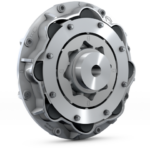
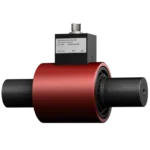
VULKAN Couplings (www.vulkan.com) has unveiled a new innovation of the Rato DS coupling that is directly connected to a composite shaft.
Aside from being a torsional coupling, the combination of high radial stiffness and low bending and axial stiffness makes the Rato DS ideal to work as an integrated misalignment coupling when it is rigidly connected to an intermediate shaft. A torsionally stiff misalignment coupling at the intermediate shaft’s rear end creates the second bending flexible pivot, which offers a double cardanic design. This unique combination of the intermediate shaft and the Rato DS is known as the VULKAN Integrated Shaft Coupling (ISC).
Even at high misalignment levels, the angular deflection of the Rato DS causes a minimal level of strain against the torque load, which results to a lower power loss. Thus, it effectively eliminates the need for a misalignment coupling between the shaft and Rato DS. The intermediate shaft can be connected directly to the coupling’s inner ring where the Rato DS is not radially supported.
The new ISC design’s advantages include the major reduction of parts, less design of the bearing and lighter weight, which leads to reduced alignment and installation efforts. The new design of the ISC also has no noise transmission path over bearing or metallic parts between the engine and gearbox. The Rato DS rubber element of the assembly provides outstanding sound isolation against structure borne noise.
Depending on the speed of the shaft the ISC design based on RATO DS can be offered with composite shafts to a maximum length of 7 m. All RATO DS coupling elements whether dual couplings or single row couplings can be utilized for the ISC design.
Low weight, low inertia torque limiter
October 1, 2010 by llangnau
Filed under Featured, Industry News, Torque Limiters
By Tobias Wolf, Product Engineer, R+W GmbH and Andrew Lechner, Product Manager, R+W America.
The concept of weight reduction through the use of high tech materials is not a new one. But for those involved in the design of motion control and automation systems, the elimination of excess mass and inertia is often the difference between success and failure. Energy savings, higher throughput rates, and reduced downtime, all without compromise to quality or accuracy, are on the minds of almost every machine design engineer today. To address this requirement R+W has introduced a revolutionary new torque limiter, SL Series, with half the inertia and less than half the mass, allowing for a rapid and automatic recovery from torque overload even in the most advanced drive technology.
The use of mechanical torque limiters is often considered to be outdated by those who prefer to control torque overload through electronic current limitation. While this is effective in many cases, as machinery becomes more dynamic, the inertia of moving parts becomes more critical. It is indeed possible to abruptly decelerate a rotating mass through unintentional blockage or application of a dynamic braking system at a faster rate than the drive would normally accelerate. This creates torque overload through reflected inertia which is completely independent of the electronic system, and can easily exceed the peak torque rating of the motor. While older and bulkier designs may be out of the question, these modern mechanical torque limiters offer a high level of sensitivity and accuracy, with increasingly smaller impact on the size, mass, balance, and power consumption of the drive system.
The SL Series uses the proven spring loaded ball detent system, along with a previously patented preload for zero backlash operation. But to achieve its target of 50% weight reduction, R+W embarked on a two year collaborative effort with local universities, designing the product from the ground up rather than simply redesigning or optimizing existing products. The result is a torque limiter constructed from state of the art materials with unique surface treatments and innovative assembly technology – surpassing weight reduction targets and simultaneously reducing its footprint. One example of this newly achieved size reduction is a torque limiter rated to disengage at 160 Nm, which in the past would have had at best a mass of 1.3 kg and a moment of inertia of 1.6 * 10-3 kgm2, now weighs 370 grams with a moment of inertia of 0.8 * 10-3 kgm2. What that amounts to is an automatic torque limiter with unparalleled power density on planet earth.
In addition to custom material specifications, specially designed spring systems, and some improvements to the ball detent configuration, resulting in a 40% increase in torque capacity for a given size, the weight reduction was also achieved through the compression of individual components. This, of course, is without negative impact on the precision or service life of the torque limiter. The SL Series, just like the previously existing R+W torque limiter designs, can handle in excess of 10,000 disengagement events, depending on rotational speed.
The four sizes (Series 30 / 60 / 150 / 300) cover disengagement torque values from 5 Nm to 700 Nm, and involve various mounting options, including both direct and indirect drive versions. Models SLN (clamping) and SLP (keyway) attach by flange to sprockets, sheaves, pulleys, and gears, and include an integral dual bearing system to support belt and chain tension when properly located over the shaft. Models SL2 (bellows coupling) and SLE (servo insert coupling) mount inline between two independently supported shafts, such as motor to ball screw connections, and compensate for the small but inevitable misalignment which exists in this type of machine layout. All four types are field adjustable, and come with both English and metric bores according to customer specifications.
R+W America
www.rw-america.com
Misumi Now Offers Comprehensive Line Of Couplings
MISUMI Coupling types include high precision Single Disc and Double Disc Clamping models, many of which may be used with servomotors. Also offered are Oldham, Slit and N Couplings, as well as Jaw, Sleeved, Bellows, and Resin types, in a variety of sizes and configurations.
The SCXW is a Double Disc type precision disc clamping coupling with high torque but no backlash. Its torsional rigidity is up to 26% higher than conventional (standard) disc clamping couplings. It suits applications requiring fast positioning precision. All the bolts are trivalent chromate plated and suitable for use in clean environments.
The MFJGWK is available as a high rigid Oldham coupling, set screw type. The MFJCGWK is a high rigid Oldham coupling, clamping type. Both products feature an aluminum bronze spacer and have a keyed bore. These couplings have allowable torque 2X higher compared to resin spacers.
The SCOC is a short Oldham coupling, clamping/spacer type. This space-saving version works with miniature devices because it is 17% shorter than conventional types.
Most MISUMI Couplings ship in six days, with the exception of the new High Rigid Oldham Couplings, which ship in eight days. Some couplings offer optional express shipping for faster delivery.
MISUMI USA, Inc.
Http://us.misumi-ec.com
Zero Backlash Coupling Ideal for Belt Driven Linear Actuators
August 9, 2010 by CouplingTips
Filed under Elastomer, Featured
Due to greater demands in modern machine design and construction, R+W has developed its EK7 series of SERVOMAX Zero Backlash Elastomer Couplings.
This coupling was specifically designed to mount to hollow bores with an expanding tapered clamping element, making it ideal for belt driven linear actuators. The EK7 provides design engineers with a number of advantages, including:
· Most belt driven linear actuators require a shaft adapter in order to couple the pulley to a motor or gear head. The EK7 eliminates the need for this additional hardware.
· In designs where motor shafts are typically mounted directly into the pulley, customer specified products often provide shafting that is too large. The EK7 can couple to the large shaft with a smaller expanding element to link the two together.
· Assemblies involving a motor, gear head and coupling used to drive the actuator can become quite large and cumbersome. The EK7 plays a small part in reducing that system size by reducing the coupling adapter flange by the length of one hub.
In addition to providing these and other novel mechanical linkage solutions, the EK7 also offers the benefits of all SERVOMAX couplings, particularly in its zero backlash torque transmission. The moment of inertia is also very low due to its low mass and low weight; ideal for high-speed servo applications where rapid acceleration/deceleration cycles exist.
The couplings are manufactured with precision machined jaws and an elastomer insert press fit between them for vibration damping and zero backlash transmission of torque. The coupling hub is custom bored and can accommodate shaft diameters from 4 to 60 mm (3/16 to 2.25 in.) and the expanding hub can accommodate bores from 12 to 70 mm (1/2 to 2.75 in.). Sizes are available for torque capacities up to 450 Nm (4,000 in. lbs.).
Torque Limiters that Keep Overload in Check for Heavy Equipment
July 7, 2010 by CouplingTips
Filed under Featured, Torque Limiters
A different approach is needed when designing mechanical torque limiters for high horsepower drives.
The basic principles of mechanical torque limiter design are similar to those that have been known since some of the first machines were built, yet it remains a dynamic field. Function, space restrictions, safety considerations and continuously changing machinery design drive the need for these components to evolve.

Typically, safety element torque limiters are supplied as a pre-set and self-contained package for integration into timing sprockets, sheaves and cardan shafts, like the one shown here.
In particular, high horsepower drives often call for mechanical design to be approached from different perspectives. As motors, gearboxes, and machines increase in size, power density can become disproportionate from one driveline component to the next, emphasizing the need for more rugged, robust and compact equipment. Precision mechanical components used in the packaging and light manufacturing automation industries, for example, may not be adequately scalable, and so be outsized quickly as drive requirements reach into the thousands of horsepower.
This disparity is seen in the design of modern torque overload release devices, the majority of which have torque release values inappropriately low for use on heavy equipment requiring operation and disconnect at torque levels beyond 10 KNm, such as large recycling equipment, gas turbines, windmill test stands, and industrial crushers. While market demand may be greater for smaller torque limiters, the availability of heavy-duty devices is critical as mass, inertia and destructive forces increase in high-powered machinery.
One exception to the rule of disproportionate size increase is perhaps the oldest and most rudimentary form of torque overload release device; the shear pin coupling. In this case, one or more pins link two rotating bodies with known yield strength located at a pre-defined radius from the center of the rotational axis. At some torque level near the calculated maximum, the pin(s) will break for a complete separation of the driving and driven shafts and fail to transmit the excessive torque.
Shear pins have protected rotating equipment for centuries, but they lack accuracy and can require much time to repair after overload. To maximize plant uptime and improve the accuracy of release torque, vendors have developed a variety of torque overload release devices with integral bearings and simple mechanical reset features. A limited number of these torque overload release devices have been reconfigured for high horsepower.
Spring tensioned torque limiters
The first widely used modern overload release devices came about in the 1930s for use in the steel industry where downtime can be expensive, and replacement of shear pins time consuming and dangerous. These parameters led to the development of the spring-tensioned form-fit torque limiter, which uses the same fundamental principle of a set release force located at a specific center distance.
In spring tensioned torque limiters, ball or roller bearings are precisely loaded into detents machined into an output flange that will break away quickly and accurately at a predefined torque level. This type of torque limiter will either ratchet or free wheel during and after overload, depending on size considerations and the rotational speed of the axis.

A slightly more sophisticated form of torque limiter is the ball-detent design. After overload release it reengages quickly.

The shear pin coupling is a rudimentary form of torque overload release device. It links two rotating bodies with known yield strength located at a pre-defined radius from the center of the rotational axis. It will break at a specific torque level and separate the driving and driven shafts so as not to transmit excessive torque. The problem with shear pins is that they lack accuracy and take time to repair.
In general, you can adjust the torque of these overload release devices by turning a single screw or spanner nut. Their ratcheting features represent a very fast and convenient means of recovery from overload, since all they require is either low speed operation or manual back driving of the axis after the blockage has been cleared. Since their initial development, hundreds of designs of “ball-detent” and “pawl-detent” mechanical torque limiters have been introduced, with a variety of adaptations made for high speed, high accuracy, light weight, and backlash free operation.
Higher horsepower needs
But, however convenient, these torque limiter designs tend to fall off at torque levels any greater than a few thousand Neutonmeters. The basic problem is that overload breakaway devices rely almost exclusively on torque as a measurable component of power.
Practical implementation of high horsepower drive systems normally involves a slow steady increase in the rotational speed of an axis, where the torque required for instantaneous acceleration would be overwhelming. Drive shafts and gearboxes, therefore, are not typically required to handle the severe peak torques associated with rapid acceleration and deceleration of the load inertia, as might be found in lighter manufacturing systems. As a result they tend not to be as large as a proportionate size increase might require in terms of pure torque capacity. This situation poses a torque density problem for mechanical overload devices.
Beyond 10 KNm common overload release designs become impractically large in outside diameter; the primary limiting factor being the spring set used to load the components together. Since industrial gearboxes, motors, and pumps tend to grow in diameter at a much slower rate than these types of torque limiters, as power increases there comes a certain point at which a traditional single spring form fit torque limiter makes no sense at all, and would tower over the equipment it was designed to protect. Clearly the lever arm component of the torque limiter design must be addressed. The simple answer is to substantially increase the force by which the individual transmission elements are loaded into the output.
There are two widely accepted approaches to overload release devices for torque in excess of 10 KNm, both of which seek to increase force over a reduced lever arm distance. One is a compact, simple design involving hydraulic pressure applied between the two otherwise free spinning surfaces. The other is based on a modified spring tensioned device similar to those previously addressed. Each has their advantages depending on the desired result.
Hydraulic versions
Hydraulic torque limiters basically apply hydraulic pressure between the two otherwise freely spinning surfaces. One or more chambers are inflated by hand to the desired pressure level, calculated as a function of release torque and based on charts provided in the manufacturer documentation. Special fluids guarantee a constant coefficient of friction throughout various operating conditions. These chambers let you apply a high level of force over a very small surface area. When the desired release torque is reached, the output will begin to slip against the input, causing the hydraulic valves to shear off, purging the fluid and fully releasing the input and output components of the torque limiter. Through an integral bearing, the load inertia coasts to a stop without further damage to the machine components or the torque limiter itself. Reconnection involves replacing the valves, refilling the chambers, and resetting the pressure.
Compared with shear pins, hydraulic torque limiters let you maintain strict control over the disengagement torque setting, which can be unpredictable with shear pins. They otherwise represent a compact choice for accurate torque overload release at tremendously high torque values, handling as much as 10,000 KNm. What they do not offer is a major reduction in the time required to recover from an overload event.
Modified spring tensioned device
For maximum plant uptime, a slightly more sophisticated form of the ball-detent design still offers the fastest means of re-engagement after overload release. Several decades ago, torque limiter manufacturers developed self-contained tangential force modules based on a plunger design. The torque density problems associated with traditional ball-detent torque limiters are then addressed through the use of one or more of these individually spring tensioned elements, which can tolerate very large tangential forces.

Spring tensioned torque limiters contain ball or roller bearings that are precisely loaded into detents machined into an output flange that will break away quickly and accurately at a predefined torque level. This type of torque limiter will either ratchet or free wheel during and after overload.
Since the individual torque transmission elements provide their own back stop for the spring tension, an array of small blocks are used, which are forced outward to clear the way for the plunger core to retract into the housing after sufficient tangential force actuates the system. The result is a “snap action,” which causes the plunger to quickly retract into the housing within a few milliseconds of overload. Once again, an integral bearing enables the load inertia to coast to a stop without further damage to the machine components or the torque limiter itself.
The key advantage to this design is the quick reloading of the individual elements into the output flange with either a gentle blow from a mallet or light pressure from a pry bar. Once the driving and driven components of the torque limiter are rotated back into the necessary orientation, re-engagement takes place quickly and easily. Depending on practical considerations, you can use pneumatic actuation systems to automate re-engagement, though future designs are likely to incorporate a more widely applicable, self contained and fully mechanical reset function.
As with traditional ball-detent torque limiters, spring tension is adjusted through the rotation of a nut, only in this case the elements are individually adjusted to the desired tangential force value, and a torque calculation is made based on the number of elements and their distance from the center of the rotational axis. While the earlier designs of safety element torque limiters involved special datasheets used in conjunction with measurements taken from the spring height, increasingly manufacturers indicate the correct nut location with a marked scale. You can make a coarse adjustment by adding or removing safety elements, which is made more plausible by torque limiter designs with the maximum number of receptacles pre-machined into the base element and with simple covers installed to guard them from contamination. The ability to make such adjustments means you do not need to ship the torque limiter back to the manufacturer for rebuilding in the case of gross miscalculation of the torque requirement.
Because of the modular design, safety element type torque limiters can be used for almost any torque release value, depending on the size and number of elements used, and limited by the maximum diameter allowed by adjacent equipment. For this reason, individual safety elements are normally made available for use into existing machinery designs or for custom coupling systems, including some used for linear force limitation.
For the most part, safety element torque limiters are supplied as a pre-set and self-contained package for integration into timing sprockets, sheaves and cardan shafts. Some manufacturers provide them as fully integrated flexible safety couplings, such as jaw, gear, and disc pack types to name a few. Custom options often include special materials, integral brake discs, high temperature felt seals, and added bearing support. As is the case in any field of design, manufacturers are driven to improve reliability and ease of use, while simultaneously reducing weight and space requirements for installation.
ServoClass® Couplings deliver high torsional stiffness
March 25, 2010 by llangnau
Filed under Featured, Industry News, Servo
ServoClass® Couplings suit applications using ac and dc servomotors that need precise positioning and the ability to handle high reverse loads. These couplings have zero-backlash and low hysteresis.
Three new sizes have been added to the ServoClass coupling line. They handle bore diameters from 0.875 in. (20 mm) to 1.378 in. (35 mm) and operating torque from 3937 to 9843 lb-in., (100 to 250 Nm). Additional sizes are available starting with the smallest bore size 0.157 in. (4 mm) and larger.
All ServoClass couplings are manufactured of RoHS compliant materials. They are lightweight and designed with 304 stainless steel disc packs and 7075-T6 aluminum hubs and center members. They are available in single and double flex models in inch and metric sizes. All models and sizes feature clamp style hubs with corrosion resistant socket head cap screws.
“ServoClass couplings provide a better option compared to beam or bellow style couplings,” reports Robert Mainz, Zero-Max sales manager. “As the cycle becomes faster, they outperform beam couplings, which experience harmful windup. Their robust design also outperforms the fragile design of bellows couplings.”
Zero-Max
www.zero-max.com
Schmidt 5D Couplings Handle Axial, Angular And Parallel Shaft Misalignments
March 19, 2010 by llangnau
Filed under Featured, Flexible, Industry News
Schmidt 5D Couplings suit applications requiring large axial, angular and parallel shaft misalignments. This “all-in-one” coupling design will handle all shaft displacements providing low backlash for precision high torque applications such as roll forming and similar heavy duty fabricating equipment.
Designed to fill an important need in the Zero-Max family of torque-rigid couplings, these couplings allow for easy adjustment to any possible misaligned shaft position without imposing heavy side loads on shafts, bearings or other machine equipment. The coupling can accommodate up to 5 degrees of angular misalignment and as high as 1.5 in. parallel misalignment while maintaining undisturbed power transmission at constant angular velocity. Acting forces within the coupling can be precisely calculated, assuring reliable, trouble-free system operation. This unique design will tolerate high shock and reversing loads with minimal or no maintenance required.
Additional features include: space-saving design and easy installation — couplings can be mounted to shaft hubs or directly to existing machine flanges (no need to reposition either shaft being coupled). Available in standard and inverted hub configurations in bore sizes from 1.500 in. to 6.375 in. or 38 mm to 160 mm. Custom designs can take this coupling design beyond the catalog specifications. The ten different model sizes handle speeds up to 1000 RPM and torque from 2800 to 500,000 in-lb. Special design modifications are available.
“The 5D coupling has very robust design features for use in applications such as roll drive systems used in converting machinery. The unique and flexible design allows for a range of movement to improve the quality of the end product.” reports Robert Mainz, Zero-Max sales manager. “They do a very good job of handling shaft misalignments and protecting drive train components in these high performance systems.”
Zero-Max
www.zero-max.com
For safety, electronics may not be the best choice
The trend of replacing mechanical systems with electrical systems continues. Even developers of hydraulic and pneumatic systems are following it. But, as is becoming evident through the latest unintended acceleration issues, electronic components can have a few drawbacks that should not be overlooked in a design.
When in comes to designing a system for safety, specifically when considering whether to choose a mechanical component such as a coupling, or to go electronic, remember this: Electronic safety components have two major disadvantages compared to mechanical safety components.
- Reaction time. Assume a machine crashes and causes an overload. According to engineers at R+W America, a signal from the monitoring circuit does not reach the motor controller until 5 to 7 ms following a sharp increase in torque. During this period of latency, the controller attempts to further increase torque to reach the setpoint value. Most likely, another 10 ms will pass before the motor is shut off. Depending on the drive train’s moments of inertia, more time can pass before the electronics brings the whole system to a stop.
- Multiple potential failure sources. Electronic monitoring systems need multiple sensors for data. Between the monitoring system and all of its sensors and other components, you have a system with multiple possible points of failure.
A mechanical safety coupling, on the other hand, completely disconnects the drive from the load within 3 to 5 ms; 1/3 of the time needed by an electronic cut-off. Noted engineers at R+W America, “electronic machine monitoring is not suitable for high speeds due to the large centrifugal mass of the rotating parts.”
Also with a mechanical safety coupling, you have one component per axis, reducing the number of possible points of failure.
Safety couplings must demonstrate two clear behaviors:
- Upon overload, separation of drive train and load should occur within a few milliseconds.
- After the coupling has disengaged, residual friction should not be excessive so as not to damage coupled components that continue to be driven due to mass moments of inertia.
According to R+W, safety couplings can be subdivided into five classes:
1. Rigid safety couplings used in indirect drive applications.
2. Torsionally rigid safety couplings for use between two shafts or flanges. These couplings resist twisting and can be subdivided into two groups.
A. Single-piece torsionally rigid safety couplings.
B. Press-fit couplings.
3. Vibration-damping safety couplings are fitted with an elastomer insert that damps incurred drive vibration.
4. Economy safety couplings suit applications requiring simple overload protection and functions as a variation of the ball-detent principle.
5. Torque-limiting line shafts, which span long distances between shafts.
(Some material, courtesy of R+W America.)
Multipurpose W-Style Couplings
Line of W-Style multi-purpose couplings are compatible with most spiral, braided and industrial hoses to handle a wide range of hydraulic applications. Designed for non-skive SAE 100 R12 and all wire braided hose applications, these couplings are available in 562 different end types and in sizes 4-32, non-skive all sizes of R12, non-skive 4SH 12-20 sizes, and a full line of metrics. They have corrosion resistant ROHS compliant plating and are compatible with most model crimpers.
Ruggedly designed to eliminate leaks in hydraulic systems, they suit industrial and commercial applications including construction, agricultural, mining, off highway vehicle, and plant maintenance equipment. Field proven in vibration and shock conditions, they are designed to handle sub-zero through high temperature applications. Kurt couplings meet SAE specifications and are quality manufactured in accordance with ISO 9002/QS 9000 quality processes and systems.
Kurt Hydraulics
www.kurthydraulics.com
Corrosion-Resistant Couplings Suitable For Multiple Applications
February 25, 2010 by CouplingTips
Filed under Featured, Safety
A full line of shaft collars and couplings for pump drive and structural systems in water treatment, pollution control, and similar facilities is available from Stafford Manufacturing Corp. of Wilmington, Massachusetts.
Stafford Corrosion-Resistant Collars and Couplings are offered in 303 and 316 stainless steel, brass, bronze, and other materials for various power transmission and structural system requirements. Featuring a wide range of sizes and styles, they are suitable for use in pump drive systems, mixing equipment, flow control instruments, and other applications exposed to water, harsh chemicals, solvents, and detergents.
Developed for water treatment, pollution control, pulp and paper, chemical plants and related facilities, Stafford Corrosion-Resistant Collars come in 1-pc, 2-pc and set-screw styles in sizes up to 16″ I.D. and the couplings in 1-pc, 2-pc, and 3-pc styles up to 6″ I.D. All can be modified with special bores, keyways, mounting holes, flats, hinges, threads, and more.