Compact safety coupling
January 19, 2011 by llangnau
Filed under Bellows, Industry News, Safety
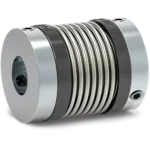
Making use of the existing BKC line of compact bellows couplings, the SL2 safety coupling is a compact, flexible and torsionally rigid option with integral torque overload release. Designed for aggressive servo driven applications, it is completely backlash free, relying on preloads and frictional connections, along with a hydroformed stainless steel bellows to relieve bearing loads resulting from misalignment.
In the event of a machine crash, power surge, or any other cause of unanticipated overload, the SL2 will disengage the motor or gearbox shaft from the load in less than 3 milliseconds. Re-engagement takes place automatically with slow speed rotation of the shaft subsequent to the overload occurrence. Available in four sizes, it handles a range of disengagement torque values from 5 to 400 Nm, and English or metric shaft diameters from 12 to 60 mm.
R+W America L.P.
www.rw-america.com
Two-Year Project Produces Safety Coupling 60-70% Lighter
October 21, 2010 by CouplingTips
Filed under Safety
The German couplings specialist R+W has developed a safety clutch which, it claims, is 60–70% lighter than conventional designs, and allows smaller clutches to be used in some applications. The SL series clutch, which made its debut at the recent Motek exhibition on Germany, is the result of a two-year collaborative project with universities.

The dramatic weight savings – which result in record ratios of torque output to weight and size – have been achieved through a combination of advanced materials and new coatings. A version with a 160Nm torque limit weighs just 370g. There are four models, with torque ratings from 5–700Nm, capable of operating at speeds of up to 10,000 rpm.
The clutches also incorporate specially designed springs and ball detent systems that are said to raise torque levels by up to 40% compared to standard safety couplings.
Torque Limiters Allows For Rapid & Automatic Recovery
October 7, 2010 by CouplingTips
Filed under Torque Limiters
R+W America’s new torque limiter, the SL Series, utilizes a proven spring-loaded ball detent system, along with a previously patented preload for zero-backlash operation.
To achieve its target of 50-percent weight reduction, R+W embarked on a two-year collaborative effort with local universities, designing the product from the ground up rather than simply redesigning or optimizing existing products. The result is a torque limiter constructed from state-of-the-art materials with unique surface treatments and innovative assembly technology – surpassing weight reduction targets and simultaneously reducing its footprint.
In addition to custom material specifications, specially designed spring systems, and some improvements to the ball detent configuration, resulting in a 40 percent increase in torque capacity for a given size, the weight reduction was also achieved through the compression of individual components.
The four sizes (Series 30 / 60 / 150 / 300) cover disengagement torque values from 5 to 700Nm, and involve various mounting options, including both direct and indirect drive versions. Models SLN (clamping) and SLP (keyway) attach by flange to sprockets, sheaves, pulleys and gears, and include an integral dual-bearing system to support belt and chain tension when properly located over the shaft. Models SL2 (bellows coupling) and SLE (servo insert coupling) mount inline between two independently supported shafts, such as motor to ball screw connections, and compensate for the small but inevitable misalignment which exists in this type of machine layout. All four types are field adjustable, and come with both English and metric bores according to customer specifications.
To achieve its target of 50-percent weight reduction, R+W embarked on a two-year collaborative effort with local universities, designing the product from the ground up rather than simply redesigning or optimizing existing products. The result is a torque limiter constructed from state-of-the-art materials with unique surface treatments and innovative assembly technology – surpassing weight reduction targets and simultaneously reducing its footprint.
In addition to custom material specifications, specially designed spring systems, and some improvements to the ball detent configuration, resulting in a 40 percent increase in torque capacity for a given size, the weight reduction was also achieved through the compression of individual components.
The four sizes (Series 30 / 60 / 150 / 300) cover disengagement torque values from 5 to 700Nm, and involve various mounting options, including both direct and indirect drive versions. Models SLN (clamping) and SLP (keyway) attach by flange to sprockets, sheaves, pulleys and gears, and include an integral dual-bearing system to support belt and chain tension when properly located over the shaft. Models SL2 (bellows coupling) and SLE (servo insert coupling) mount inline between two independently supported shafts, such as motor to ball screw connections, and compensate for the small but inevitable misalignment which exists in this type of machine layout. All four types are field adjustable, and come with both English and metric bores according to customer specifications.
Low weight, low inertia torque limiter
October 1, 2010 by llangnau
Filed under Featured, Industry News, Torque Limiters
By Tobias Wolf, Product Engineer, R+W GmbH and Andrew Lechner, Product Manager, R+W America.
The concept of weight reduction through the use of high tech materials is not a new one. But for those involved in the design of motion control and automation systems, the elimination of excess mass and inertia is often the difference between success and failure. Energy savings, higher throughput rates, and reduced downtime, all without compromise to quality or accuracy, are on the minds of almost every machine design engineer today. To address this requirement R+W has introduced a revolutionary new torque limiter, SL Series, with half the inertia and less than half the mass, allowing for a rapid and automatic recovery from torque overload even in the most advanced drive technology.
The use of mechanical torque limiters is often considered to be outdated by those who prefer to control torque overload through electronic current limitation. While this is effective in many cases, as machinery becomes more dynamic, the inertia of moving parts becomes more critical. It is indeed possible to abruptly decelerate a rotating mass through unintentional blockage or application of a dynamic braking system at a faster rate than the drive would normally accelerate. This creates torque overload through reflected inertia which is completely independent of the electronic system, and can easily exceed the peak torque rating of the motor. While older and bulkier designs may be out of the question, these modern mechanical torque limiters offer a high level of sensitivity and accuracy, with increasingly smaller impact on the size, mass, balance, and power consumption of the drive system.
The SL Series uses the proven spring loaded ball detent system, along with a previously patented preload for zero backlash operation. But to achieve its target of 50% weight reduction, R+W embarked on a two year collaborative effort with local universities, designing the product from the ground up rather than simply redesigning or optimizing existing products. The result is a torque limiter constructed from state of the art materials with unique surface treatments and innovative assembly technology – surpassing weight reduction targets and simultaneously reducing its footprint. One example of this newly achieved size reduction is a torque limiter rated to disengage at 160 Nm, which in the past would have had at best a mass of 1.3 kg and a moment of inertia of 1.6 * 10-3 kgm2, now weighs 370 grams with a moment of inertia of 0.8 * 10-3 kgm2. What that amounts to is an automatic torque limiter with unparalleled power density on planet earth.
In addition to custom material specifications, specially designed spring systems, and some improvements to the ball detent configuration, resulting in a 40% increase in torque capacity for a given size, the weight reduction was also achieved through the compression of individual components. This, of course, is without negative impact on the precision or service life of the torque limiter. The SL Series, just like the previously existing R+W torque limiter designs, can handle in excess of 10,000 disengagement events, depending on rotational speed.
The four sizes (Series 30 / 60 / 150 / 300) cover disengagement torque values from 5 Nm to 700 Nm, and involve various mounting options, including both direct and indirect drive versions. Models SLN (clamping) and SLP (keyway) attach by flange to sprockets, sheaves, pulleys, and gears, and include an integral dual bearing system to support belt and chain tension when properly located over the shaft. Models SL2 (bellows coupling) and SLE (servo insert coupling) mount inline between two independently supported shafts, such as motor to ball screw connections, and compensate for the small but inevitable misalignment which exists in this type of machine layout. All four types are field adjustable, and come with both English and metric bores according to customer specifications.
R+W America
www.rw-america.com
Servo Coupling Handles 2.9x More Lateral Misalignment
September 15, 2010 by CouplingTips
Filed under Servo
The trend in industry to process more material faster and more efficiently calls for a high-torque, high-misalignment, low-inertia servo coupling, with minimal compromise to torsional stiffness. Stainless-steel bellows couplings have the highest torsional stiffness of commercially available flexible couplings, making them the best choice for aggressive servo-driven applications. But in cases where the two shafts to be connected are mounted to different bearing surfaces, it can be difficult to maintain the precise alignment tolerances normally required.
Utilizing a special, high-stiffness bellows and new, high-strength connection method, R+W’s BKZ handles an average of 2.6 times the traditional torque rating at a given outside diameter, and an average of 2.9 times more lateral misalignment, opening up the benefits of precision bellows couplings to a whole new segment of machine design and servo motion control.
Accepting bore diameters ranging from 15 to 60 mm and torque ratings from 20 to 1,000Nm, the BKZ range is available in four sizes, with a variety of materials, finishes and the optional self-opening clamp system.
Stainless Steel Servo Insert Coupings
March 10, 2009 by R. Nelson Parrish
Filed under Jaw
Bensenville, IL - Stainless steel SERVOMAX couplings from R+W feature a highly chemically resistant elastomer element that is press fit between two precision machined coupling halves, giving it zero backlash and guaranteed concentricity. The inserts, available in four different Shore hardnesses, depending on the damping and torque rigidity required, are heat treated within the precision machined hub, removing inconsistencies in the surface area in contact, and significantly improving rotational positioning accuracy as the result. These servo couplings exhibit a very high torque density and very smooth running due to the tight concentricity tolerance in the overall design.
The RoHS compliant SERVOMAX couplings in stainless steel are ideal for packaging, food processing, semiconductor, and other applications requiring frequent cleaning or exposure to the elements. They are available in 9 different sizes with torque capacities from 2Nm (17.7 lbs/in) to 2150Nm (19,027 lbs/in) and can accept English or metric bores, with or without keyways, in the 3mm to 80mm range.
Contact R+W America at 888-479-8728 or www.rw-america.com for more information.
Handbook for Mechanical Torque Limiters
February 17, 2009 by R. Nelson Parrish
Filed under Industry News, Safety
As a part of a series of technical handbooks developed for the European manufacturing industry, R+W has released a new handbook for the design and application of safety and overload couplings.

Covering the very basics of what torque limiters are, the varieties available, and why they are used, all the way though complex theories and advanced sizing formulas used to determine optimum coupling selection, this handbook includes information for all levels of design engineers with a potential need for torque overload protection. This is the second of a two part series, with the first book handling the design and application of precision couplings and line shafts. Contact R+W America for more information.