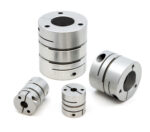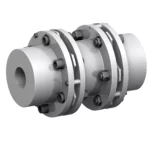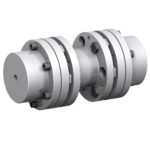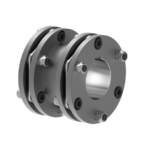
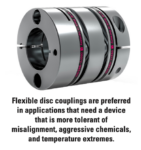
Couplings for higher speed applications

November 4, 2011 by  
Filed under Disk, Rigid, Servo

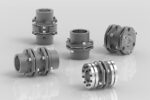
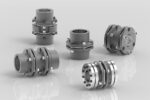
6159 Zero Max Photo 02 300x254 ServoClass Couplings feature high torsional stiffness, zero backlash and low hysteresis to ensure repeatable precise positioning at speeds up to 10,000 rpm. Their robust design ensures precise system operation in automated 24/7 applications. That is especially true where stresses occur at increased speeds in a servo system. Designed with 304 stainless steel disc packs and 7075-T6 aluminum hubs, the couplings are inherently strong, durable and precisely balanced. To ensure precise alignment of the assembled components, ISO 4762 CL12.9 corrosion resistant socket head cap screws are used with a carefully controlled assembly process. The couplings are available in single and double flex models in inch and metric bore sizes from 0.157 in. (4mm) to 1.750 in. (45mm). All models and sizes feature clamp style hubs and operate in temperatures from -22° to +212° F (-30° to +100° C).

Zero-Max
www.zero-max.com


Misumi Now Offers Comprehensive Line Of Couplings

August 12, 2010 by  
Filed under Bellows, Disk, Featured, Industry News, Miniature, Oldham, Servo

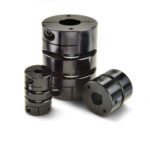
MISUMI Coupling types include high precision Single Disc and Double Disc Clamping models, many of which may be used with servomotors.  Also offered are Oldham, Slit and N Couplings, as well as Jaw, Sleeved, Bellows, and Resin types, in a variety of sizes and configurations.

misumi couplings2

The SCXW is a Double Disc type precision disc clamping coupling with high torque but no backlash.  Its torsional rigidity is up to 26% higher than conventional (standard) disc clamping couplings. It suits applications requiring fast positioning precision.  All the bolts are trivalent chromate plated and suitable for use in clean environments.

The MFJGWK is available as a high rigid Oldham coupling, set screw type. The MFJCGWK is a high rigid Oldham coupling, clamping type.  Both products feature an aluminum bronze spacer and have a keyed bore.  These couplings have allowable torque 2X higher compared to resin spacers.

The SCOC is a short Oldham coupling, clamping/spacer type. This space-saving version works with miniature devices because it is 17% shorter than conventional types.

Most MISUMI Couplings ship in six days, with the exception of the new High Rigid Oldham Couplings, which ship in eight days.  Some couplings offer optional express shipping for faster delivery.

MISUMI USA, Inc.
Http://us.misumi-ec.com

High-Torque Disk Couplings Resist Fretting

May 26, 2010 by  
Filed under Disk

Torsiflex disk couplings are torsionally stiff and backlash-free, incorporating an anti-flail feature. The couplings also withstand significant levels of misalignment without loss of operating performance.

pw bibby

The design drives in friction, rather than shear, to the disc coupling by using large aircraft-quality bolts on the disk hubs. As a result, the pack of blades in the coupling can befirmly clamped together to prevent fretting. In contrast, the use of smaller bolts does not allow the same torque to be achieved across the blades, so fretting is more likely to occur and the possibility of premature failure of the coupling. The disk couplings are rated for loads from 0.26 to 85 kNm, and speeds from 8,000 to 3,600 rpm (smallest to largest).

Bibby Transmissions, An Altra Industrial Motion Company
www.AltraMotion.com

GERWAH® Product Line

The GERWAH® line of products consists of magnetic couplings, metal bellows couplings, servo-insert couplings, line shafts, RING-flex® couplings and safety couplings. These couplings are available in a range of sizes and torque capacities to 3,800 lb-ft. The low mass of the lightweight construction helps increase machine performance and reduce energy costs.

1307 162 Ringfeder 1855AB text 300x228

Ringfeder Power Transmission USA Corporation markets a range of power transmission components and keyless shaft/hub technology.  Other power transmission products include shock absorbing devices, flexible elastomeric couplings, flexible disc couplings and torque limiters along with other specialty and custom made products.

RINGFEDER

www.ringfeder.com

Six factors to remember about couplings in a motion system

March 25, 2010 by  
Filed under Beam, Bellows, Disk, Elastomer, Flexible, Linear, Oldham, Rigid, Servo

Physical values such as torque, torsional rigidity, spring stiffness, moment of inertia, imbalance, and zero-backlash play a major role in coupling design. Here are a few facts to keep in mind when you design your motion system.

BKZ 300x215

Torque (Nm): is the product of an acting force and the effective length of the acting force’s lever arm.

T = Fxr

T = Torque (Nm)

F = Force (N)

r = Lever arm (m)

With a force of 100 N and a 1 m long lever arm, you can generate a torque of 100 Nm. Or, you can generate a torque of 100 Nm with a force of 1000 N and a 0.1 m long lever arm. For couplings, a specific amount of torque can be achieved with a large outer diameter of the coupling and a correspondingly low acting force or with a small outer diameter and a correspondingly high acting force.

Torsional rigidity (Nm/rad): refers to the rigidity of a coupling when it is subjected to a torsional load. If the torque exceeds the maximum torsional value of the coupling, the coupling will no longer be strong enough to transmit the acting rotational force. Ex: If a coupling with a torsional rigidity of 10 000 Nm/rad is subjected to 10 Nm, the connection element will twist by 1/1000 rad. That is equal to an angle of twist of about 0.057 degrees (1 rad = 57°17’44.8”). For a torsionally rigid or vibration damping coupling, this angle of twist may still be within the admissible range.  In practice, torsionally rigid couplings normally have a maximum angle of twist of less than 0.05 degrees and vibration damping couplings have a maximum angle of twist of less than 5 degrees.

Spring Stiffness (N/mm): is the counterforce exerted by the coupling in case of differentiated position of the axes in an axial, radial, and lateral direction. Ex: If the axial spring stiffness of a coupling is 30 N/mm, the coupling will exert a force of 30 N in the case of an axial displacement of 1 mm. These forces are important in a design with couplings, particularly when selecting bearings or other drive system components.

Moment of inertia: is the moment resistance when the rotational speed is changed. Normally, the lower the total weight and the smaller the outer diameter of the coupling body, the lower the moment of inertia. The reverse is also true, the higher the weight and larger the outer diameter, the higher the moment of inertia. This feature is important in highly dynamic applications because the drive has to generate sufficient torque to overcome a body’s moment of inertia to accelerate and decelerate.

Imbalance: in a drive system, imbalance should be as low as possible for smooth operation. Caused by asymmetries in the drive system where mass is distributed unevenly, it affects centrifugal forces on the entire drive system. It can be rectified by “balancing bores,” which are normally drilled directly into the location of the disproportionally high concentration of mass.

Zero backlash: is a lack of empty space or “play” when the rotational speed, direction of rotation, or torque changes. It does not mean that there is no angle of twist. Backlash is an important factor in predicting bearing life.

Information courtesy of R+W America

Rw-america.com

Tips to simplify coupling selection

August 19, 2009 by  
Filed under Beam, Bellows, Disk, Featured, Jaw, Oldham, Rigid

For a coupling in a servo application to work properly, you need to satisfy a number of application factors including: torque, shaft misalignment, stiffness, speed, and space requirements.

Here’s a look at the available types of servo couplings and what you need to consider for each of them during the selection process.

Beam couplings
Beam type couplings are manufactured from a single piece of material, usually aluminum, and use a system of spiral cuts to accommodate misalignment and transmit torque.  For many applications, beam couplings are a good economical and maintenance free choice.

The single piece design transmits torque with zero backlash. Two basic variations exist: a single beam style and a multiple beam style.

The single beam style has one long continuous cut that usually consists of multiple complete rotations. It is very flexible and accommodates light bearing loads.

oct%20mc%20feat%201
For many applications, flexible beam couplings are a good economical and maintenance free choice.

It is able to manage all types of misalignment, but works best with angular misalignment or axial motion. It is not well suited to parallel misalignment because the single beam must bend in two different directions simultaneously, creating larger stresses in the coupling that could cause premature failure.

Under misalignment conditions, the long single beam allows the coupling to bend easily. But the relatively large amount of windup under torsional loads adversely affects the coupling’s accuracy.

Single beam couplings are an economical option best used in lower torque application and in connections to encoders and other light instruments.

oct%20mc%20feat%202

Multiple beam couplings, which usually consist of two or three overlapping beams, attack the problem of low torsional rigidity. The use of multiple beams lets the beams be shorter without sacrificing much of the misalignment capabilities.

The shorter beams make the coupling torsionally stiff. Overlapping them so the beams work in parallel increases the allowable maximum torque making them suitable for use in light duty applications with connections, such as from a servo to a leadscrew. A drawback is that bearing loads are increased by a sizeable amount over the single beam variety but, in most cases, remain low enough to protect bearings effectively.

Some manufacturers take the multiple beam concept to another level. Instead of using a single set of multiple cuts, they use two sets. The use of multiple sets of cuts gives the coupling additional flexibility to accept more misalignment, including parallel misalignment. With parallel misalignment, one set of beams bends in one direction and the second set bends in the other direction.

Most commonly, these couplings are made of aluminum, but they also come in stainless steel. Stainless protects against corrosion, and increases coupling torque capacity and stiffness to sometimes double that of aluminum versions. The increase in torque and stiffness, though, is offset by a dramatic increase in mass and inertia. Keep in mind that in applications using smaller motors, a large percentage of the motor’s torque is used to overcome the inertia of the coupling.

Oldham couplings

The Oldham coupling is a three piece coupling comprised of two hubs and a center member. The center disk, which is usually made of a plastic or, less commonly, a metallic material, transmits the torque. On the center disk, mating slots are located on opposite sides and oriented 90 degrees apart. Drive tenons are located on the hubs. The slots of the disk fit on the hub tenons with a slight press fit that allows the coupling to operate with zero backlash. Over time, the sliding of the disk over the tenons will create wear to the point where the coupling will experience backlash. The disks are inexpensive items easilyreplaced, so a new insert will restore the coupling’s original capability.

oct%20mc%20feat%204
The choice of materials for Oldham couplings depends on requirements for backlash, stiffness, vibration, and noise.

In operation, the center element slides on the hub tenon to accommodate misalignment.

The only resistance to misalignment is the frictional force between the hub and disk, Oldham couplings have bearing loads that do not increase as misalignment increases. Unlike other types of couplings, there are no bending members that cause bearing loads to increase as the shafts get out of alignment.

These couplings only allow a small amount of angular misalignment (less than one-half a degree) and axial motion (less than 0.005 in.), and are limited to speeds of 4000 rpm. Larger amounts of angular misalignment cause the coupling to lose its constant velocity characteristic, and axial motion is limited by the three-piece design of the coupling, which does not allow for use in push-pull types of applications. Because the center disk is a floating member, both shafts must be supported to keep the coupling from falling apart.

oct%20mc%20feat%203
Bellows couplings easily bend under loads that result from angular, parallel, and axial motion.

Oldham couplings can handle relatively large amounts of parallel misalignment, from 0.025 in. to 0.100 in. or more depending on coupling size. Coupling manufacturers generally provide smaller misalignment ratings to obtain longer life ratings. These ratings can be surpassed at the expense of coupling life.

These couplings are available in a range of disk materials. The choice depends on requirements for zero backlash, high torsional stiffness and torque, or vibration absorption and low noise. Nonmetallic inserts are electrically isolating and can act as a mechanical fuse. When the plastic insert fails, it breaks cleanly and does not allow transmission of power, preventing other damage from occurring to machinery components.

Zero backlash jaw couplings
Jaw couplings are either conventional straight jaw or curved jaw zero backlash versions. Conventional straight jaw couplings are not typically well suited to servo applications that require the accurate transmission of torque. Zero backlash jaw couplings, on the other hand, are well suited to servo applications. The curved jaws help to reduce deformation of the spider and limit the effects of centrifugal forces during high-speed operation.

oct%20mc%20feat%205
Jaw couplings handle high-speed applications well, but are less able to handle large amounts of misalignment.

Zero backlash jaw couplings consist of two metallic hubs and an elastomer insert commonly referred to as a “spider.” The spider is a multiple lobed insert that fits between the drive jaws on the coupling hubs with a jaw from each hub fitted alternately between the lobes of the spider. As in the oldham coupling, there is a press fit between the jaws and the spider for the coupling to deliver zero backlash.

In contrast to the oldham coupling, where the torque disk is in shear under torsional loads, the jaw coupling’s spider operates in compression. Be careful not to exceed the manufacturer’s rating for maximum torque, which can be significantly below the physical limitations of the spider. The spider can be compressed so that there is no longer a preload and backlash will occur.

Jaw couplings are well balanced and able to handle high-speed applications, 40,000 rpm or more. They do not handle very large amounts of misalignment, especially axial motion. Large amounts of parallel and angular misalignment cause loads on bearing to be higher than those of most other types of servo couplings.

If a spider fails, the coupling will not disengage. The jaws from the two hubs will mate similar to teeth on two gears and continue to transmit torque with metal-to-metal contact. Depending on the application, such action may be desirable or it could cause problems in the overall coupling system.

An advantage of the jaw coupling is the ability to mix and match spiders based on the application. Manufacturers of zero backlash jaw couplings offer multiple materials with different hardnesses and temperature capabilities that let you choose exactly the insert that meets the application’s performance criteria.

Disk couplings

At minimum, disk couplings have two hubs and a thin metallic or composite disk that transmits the torque. The disk is fastened to the hubs usually with a tight fitting pin that eliminates any play or backlash between the parts.

oct%20mc%20feat%206
Torsionally stiff, disc couplings can accept up to 5 degrees of misalignment with some of the lowest bearing loads available.

Some manufacturers offer disk couplings with two disks separated by a rigid center member attached to a hub at each end. The rigid center member is usually metallic, but plastic versions are available and can be used to electrically isolate the coupling. This configuration will reduce torque capacity and torsional stiffness.

The difference between the two variations is similar to the difference between the single beam style coupling and the multiple beam coupling with two sets of cuts. The single disk coupling is not adept at accommodating parallel misalignment due to the complex bending of the disk. The two-disk style allows each disk to bend in opposite directions to harness the parallel offset. The properties of this type of coupling are similar to those of bellows couplings. They transmit torque in a similar manner. The disks are very thin, allowing them to bend easily under misalignment loading, which allows the coupling to accept misalignment up to 5 degrees with some of the lowest bearing loads available in a servo coupling.

Torsionally, the disks are very stiff. The disk coupling has stiffness ratings slightly lower than that of bellows couplings. A downside to these couplings is that they are delicate and prone to damage if misused or installed improperly. For proper operation, take care to insure that the misalignment is within the coupling ratings.

Bellows couplings

The Bellows coupling is an assembly of two hubs and a thin walled metallic bellows. In most cases, welding or an adhesive marry the hubs to the bellows.

Although other materials can be and are used, the two most common materials for the bellows are stainless steel and nickel. Nickel bellows are made using an electrodeposition method. It involves machining a solid mandrel in the shape of the finished bellows. The nickel is electrodeposited onto the mandrel, which is then chemically dissolved leaving behind the finished bellows. Manufacturers can precisely control the wall thickness of the bellows, creating thinner walls than is possible with other methods of bellows forming.

oct%20mc%20feat%207
Rigid couplings can suit servo applications, especially if misalignment is tightly controlled.

The thinner walls give the coupling greater sensitively and responsiveness, which makes them suitable for precise small instrumentation applications. However, thinner walls also reduce the torque capacity of the bellows putting a limit on useful applications.

Stainless steel bellows are stronger than nickel versions and usually manufactured through hydroforming. A thin walled tube is placed into a machine and hydraulic pressure is used to form the convolutions of the bellows around specialized tooling.

The uniform thin walls of bellows allow it to bend easily under loads caused by the three basic types of misalignment between shafts: angular, parallel, and axial motion. Generally, bellows allow for up to 1 to 2 degrees of angular misalignment and 0.010 in. to 0.020 in. of parallel misalignment and axial motion.

The thin, uniform walls result in low bearing loads that remain constant at all points of rotation, without the damaging cyclical high and low loading points found in some other types of couplings. All of this is accomplished while remaining rigid under torsional loads.

Torsional rigidity is a key factor in the accuracy of the coupling. The stiffer the coupling, the more accurately it translates motion from the motor to the driven component. In the area of servo couplings, bellows type couplings are some of the stiffest available, making them ideal in applications that require a high degree of accuracy and repeatability. Some manufacturers offer bellows couplings with stainless steel hubs, which can be useful in applications requiring corrosion resistance, but their mass can be a factor in their operation. A coupling with aluminum hubs has very low inertia, a feature important for highly responsive systems. Some manufacturers balance their couplings to suit high-speed applications of more than 10,000 rpm.

Rigid couplings
These couplings were not often considered for servo application. Recently, however, smaller sized rigid couplings, especially in aluminum, operate in motion control applications because they offer high torque capacity, stiffness, and zero backlash. Torsionally rigid with virtually zero windup under torque loads, they are also rigid under loads caused by misalignment.

If misalignment is present in the system, however, the shafts, bearings or coupling will fail prematurely. Thus, the couplings cannot be run at extremely high speeds because they cannot compensate for thermal changes in the shafts from heat buildup in high-speed use.  However, in servo applications where misalignment can be tightly controlled rigid couplings perform admirably.

Ruland Manufacturing Company, Inc.
www.ruland.com

Inch & Metric Magnetic Disk Couplings

June 24, 2009 by  
Filed under Disk, Magnetic

New Hyde Park, NY – A new series of magnetic disk couplings from Sterling Instrument (ISO 9001:2000+AS9100B Registered Manufacturer) features no friction or wearing parts, uses no electricity and no magnetic particles to leak. These units, identified as the S50DCM… (inch) and S50DCMM… (metric) Series are stocked in 8 different bore sizes ranging from .1875″ to 1.000″ (5 mm to19 mm).The couplings consist of two opposing disk halves with powerful rare earth magnets. The torque applied to one disk is transferred through an air gap to the other disk. Because of its simple flat design, one can have angular misalignment of up to 3o or parallel misalignment of up to 1/4″ and still transmit nearly full rotational torque.

magnetic coupling

These 416 Stainless steel couplings incorporate an NdFeB, nickel plated magnet. The hub sections are offered singularly and are offered with or without a keyway and are fastened to shafts with an included set screw. The coupling O.D. ranges from 1.72″to 2.86″ (43.7 mm to 73 mm).

Other features include being incredibly accurate, repeatable torque control, and easy to adjust, easy to apply, smooth with no friction since there is no physical contact between driving and driven parts.

Sterling Instrument
www.sdp-si.com

Composite Disc Couplings for the Wind Turbine Industry

June 16, 2009 by  
Filed under Disk

Plymouth, MN – Zero-Max, Inc.announces introduction of its Composite Disc Couplings for the wind turbine industry.

“These couplings withstand extreme misalignment while remaining torsionally stiff and have passed the ‘hell hole’ test at Tehachapi, California Wind Farm,” reports James Motz, member of the Wind Team for Zero-Max.

zero max wind turbine

“The couplings were tested under conditions simulating a 20 year load spectrum of continuous operation. Once fatigue tested, the ‘hell hole’ location was selected for field testing in a wind turbine whereby the coupling would experience wind conditions in excess of 80 mph with continuous wind direction changes. The Zero-Max couplings survived these conditions that put over 50 wind turbines not using our coupling out of commission. The Zero-Max coupling continues to operate uninterrupted at this writing,” Mr. Motz added.

The Zero-Max wind turbine couplings are designed with composite disk packs at both ends of a center spacer. These patented designed disk packs provide the true strength and calculable flexibility of the coupling. The composite disk packs (flex elements) provide a distinct advantage over other coupling component designs by allowing a surplus of parallel and axial misalignment while remaining torsionally stiff through all harmonic ranges of the wind turbine’s oscillating load.

Depending on application, the Zero-Max’s center spacers can be machined out of steel, composite glass fiber or 6061-T6 aluminum. Through the use of Finite Element Analysis (FEA), these center spacers can be engineered to withstand in excess of 70,000 Nm of torque depending on the material selected.

Zero-Max wind turbine couplings have many additional design advantages. The flex elements electrically insulate the turbine’s generator from the gear box, eliminating amperage leak across the coupling thus preventing gear box damage. The coupling protects the generator by transferring lower reaction loads to the generator bearings. Also, the coupling’s composite material withstands all types of environmental elements including temperature extremes from -57 to +121°C and from moisture and chemicals native to wind turbines.

Zero-Max
www.zero-max.com

High Performance from Miniature Disc Couplings

March 5, 2009 by  
Filed under Disk

08088cb2931d9ce06827a6141441d8ea Marlborough, MA – Ruland offers miniature disc couplings both in single and double disc styles. Disc couplings are high performance motion control couplings with zero-backlash, excellent speed capabilities up to 10,000 rpm, strength and torsional stiffness characteristics, as well as low inertia for today’s highly responsive systems. Disc couplings are often used in servomotor and lead screw applications. In addition, two single disc couplings are often used in tandem when greater misalignment or a longer distance is required such as on gantry systems.

Disc couplings are an assembly of two black anodized aluminum hubs, multiple flat stainless steel disc springs to transmit torque, and a center spacer for double disc styles. The thin discs allow for a substantial amount of misalignment between shafts, while remaining rigid under torque loads. Parallel misalignment is accommodated by the double disc style or by two single disc couplings used in tandem.

Double disc styles are available with either an anodized aluminum center spacer or an electrically isolating acetal center spacer. Both disc couplings types are offered in clamp style and set screw style, with standard outer diameters from 15mm to 57mm, and bore sizes from 1/8″ to 1 1/4″ in the inch series and 3mm to 30mm in the metric series. Couplings with different bores sizes including mixed inch and metric are available.

Disc couplings are part of Ruland’s complete product line which includes shaft collars and rigid couplings with precision honed bores and five types of zero-backlash motion control couplings: beam couplings, bellows couplings, oldham couplings, curved jaw couplings and miniature disc couplings.

www.ruland.com

Sliding Disc Coupling Provides Design Flexibility

February 12, 2009 by  
Filed under Disk, Oldham

The design and manufacture of customised linear positioning systems on short lead times is key to LinTech’s success. This California-based company offers an exceptionally wide range of options enabling its customers to create the optimum system for the job. 

To compensate for misalignment between the motor shaft and screw (or belt) drive shaft extension LinTech’s product programme includes the choice of three different coupling types. The middle option is especially apposite to LinTech’s policy as it too can be tailored to suit the specific needs of the application. This flexibility is provided by the Oldham Series couplings, which are manufactured and supplied by Huco Dynatork. 

This British manufacturer of precision drive products was the first to employ the sliding coupling designed by the 19th century engineer, John Oldham, for locomotive applications. It introduced a plastic torque disc to achieve zero backlash and applied the principle to modern precision drives. The Oldham coupling has been central to the Huco product programme since the mid ‘80s. 

The 3-part sliding disc Oldham coupling is typically recommended by LinTech for applications that involve high acceleration and the starting and stopping of high inertial loads. Naturally it is supplied in a choice of diameter and length sizes and with bore diameters to accommodate various NEMA and metric motor shafts. However, it is the choice of hub styles and disc materials associated with this coupling that has particular appeal for LinTech. The hubs determine the method of installation and shaft attachment and the discs, the quality of motion. 

The Oldham is precision engineered throughout and comprises two hubs with inward facing tenons. These engage with matching slots spaced at 90° in a central lightweight torque disc. As the coupling rotates, the disc compensates for any parallel shaft offset by sliding the commensurate distance along each tenon in turn. A hard, low friction facing on the working surface guarantees long, trouble-free operation. 

Quality of motion is a function of the carefully controlled relationship between the tenons and the torque disc. The disc is precision moulded from high grade engineering polymers and, being easily replaced at low cost, is the sacrificial element in the drive train. A choice of torque discs is available including those resistant to radiation and heat. If severely overloaded the torque disc will break, acting as a mechanical fuse, thereby protecting associated equipment from damage. A replacement torque disc quickly restores the drive without the need to dismantle the drive system. 

“We like the flexibility of mixing and matching different bore hubs to create a total coupling for an application,” explains Gary Wester, Vice President of Sales. “And we favour standard nylon torque disc that provides a nice degree of system damping between the motor output vibrations and the input shaft on our positioning slide.” 

This ability to fine-tune the component to the exact performance requirements of the application has earned LinTech a substantial customer base. Its systems are used in a broad variety of general automation applications but particularly for precise positioning in the medical, automotive and packaging sectors.

www.huco.com

Next Page »