
Rebar Coupling Saves Time & Money
November 27, 2009 by CouplingTips
Filed under Beam
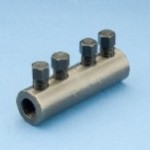
The LENTON® LOCK S-Series, part of the LENTON LOCK Mechanical Rebar Splicing System from ERICO®, provides many of the same great benefits as the B-Series, except in a smaller package. This unique bolted splice is smaller than the competition and has fewer bolts, which helps reduce installation time and save money on the jobsite. All LENTON LOCK couplers feature patented gripping technology that provides overall structural integrity in tension, compression and stress-reversal applications.
With a performance that exceeds 125% of specified yield on ASTM® A615 Grade 60 rebar, this innovative mechanical rebar splice is designed for use in column splicing, bridge applications, piling, splicing to protruding dowels cast in concrete, closure pours, beams, chimney construction and other demanding splicing applications.
The couplers allow for easy field installation since no bar-end preparation, sawing or swaging is necessary, and they can be installed with just a standard wrench or an impact wrench, depending on coupler size. The bolt heads will shear off when proper installation tightness has been reached, which allows for complete visual inspection.
The S-Series is ideal for use in repair, bent bar, retrofit, precast closure pour and new construction applications. The couplers meet or exceed major international building codes and Department of Transportation requirements, including ACI® 318 Type 1, UBC® Type 1 and IBC® Type 1.
There is no need to stock multiple parts to accommodate one-step transitions. LENTON LOCK works as a one-step transition on ASTM (in-lb) rebar. For Canadian rebar sizes, contact ERICO for transition compatibility.
Variacor Coupling: Built for Flexible Hoses
November 20, 2009 by CouplingTips
Filed under Flexible
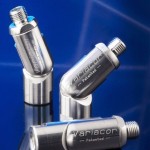
A new pipe fitting which provides free orientation for hydraulic and pneumatic hoses and tools across a wide range of industrial applications has been introduced by spray nozzle specialists BETE Ltd. The patented Variacor® coupling ensures hosing can be flexible and multi-directional and so brings important benefits to users. For example, the innovative design of the coupling ensures optimum flexibility which results in less wear on hoses and so reduces costs. Also, increased maneuverability of the hose means easier handling for the user while the lower pressure and flow losses compared to conventional couplings, results in a more consistent and improved flow.
The coupling for hydraulic hose applications provides free rotation through 360° for both sides of the fitting while the pneumatic option ensures free rotation of 360° for one side of the fitting and 90° for the other. This 360° / 90° combination also applies to the coupling which is designed for wash guns.
The Variacor coupling is ideal for connecting two runs of rigid pipe or flexible hose, or an end fitting, such as a nozzle or gun. It is a simple, but highly effective means of changing the angle of flow direction, axially between 180° and 90°, with a full 360° swivel at either, or both ends. Adjustments are manual, instant and can be free or lockable. Directional change is achieved by a simple slide turn of the outlet section against the inlet section of the connector.
Neo-Flex Couplings from Advanced Antivibration Components
November 10, 2009 by CouplingTips
Filed under Featured, Flexible
New Hyde Park NY — A new series of metric Neo-Flex couplings from Advanced Antivibration Components – AAC feature excellent torsional vibration isolation plus shaft-to-shaft insulation. The center of these couplings, identified as the V50FSR-… (inch) and V50FSRM… (metric) for the Short Series, and V5DFLR-…(inch) and V5DFLRM (metric) for the Long Series, are made from 73 durometer molded neoprene along with 303 stainless steel hubs. They are featured at the AAC eStore where you can order online, request a quote, download CAD models, check stock plus view catalog and technical pages.

They are stocked in two hub styles, conventional pin type hubs which use a set screw for fastening and a Fairloc® version. Fairloc® is a patented integral hub fastener which eliminates marred shafts. The choice of Fairloc® hubs permits frequent phase adjustment, timing and position adjustment while adding positive metal-to-metal fastening strength along both hub sections. The Fairloc® integral hub fastener consists of two slots that are machined into the hub, one radially the other angularly, to create a transverse wedge which remains attached to the solid portion of the hub on one side. The resultant cantilevered clamping section has a tapped hole to accept a cap screw which passes through a clearance hole in the solid portion of the hub, and into a threaded hole in the transverse wedge section. As the screw is tightened, the cantilevered section clamps the shaft securely. The screw can be tightened and released repeatedly without marring the shaft or affecting its torque-transmitting abilities.
They are stocked with both ribbed and smooth style center sections. The ribbed style features an angular misalignment of 5° or 15° (long style) and a parallel offset of 0.25 mm (.010″)(short style) or 0.38 mm (.015″)(long style). The smooth style features an angular misalignment of 1° (short style) or 8° (long style) and a parallel offset of 0.13 mm (.005″)(short style) or 0.25mm (.010″)(long style). They are designed to fit 3 to 6 mm metric shafts or .1200, 1/8, 3/16 and 1/4 inch shafts.
Advanced Antivibration Components – AAC
www.vibrationmounts.com/NewProducts/NeoFlexCouplings.htm
Silicone Insert Couplings from Sterling Instrument
November 9, 2009 by CouplingTips
Filed under Featured, Industry News, Rigid
New Hyde Park, NY — A new series of silicone insert couplings from Sterling Instrument (ISO 9001:2000+AS9100B Registered Manufacturer) features electrical isolation and no backlash. These metric couplings, identified as the S54HSAM… (clamp type) and S5PSAM… (set screw type) Series are stocked in 5 different bore sizes ranging from (6 mm to 16 mm).
![]()
These couplings have aluminum hubs with either set screws or clamps for fastening to shafts. The insert is silicone 40 ShA. Operating temperature ranges from -50°C to +150°C. They range in length from 26.5 mm to 57 mm. Their maximum speed is 5000 rpm.
They can be used in various applications and are especially able to accommodate tight or skewed connections. Quotes, online orders, available stock, and 3D CAD Model downloads are available at our new eStore at: www.sdp-si.com/eStore. SDP/SI offers over 1000 different types of couplings including inch and metric: magnetic, flexible, rigid, oldham, bellows, flexible shaft, spider type, Fairloc® shaft type, helical, slit-type, and neoprene flexible type couplings.
Sterling Instrument
www.sdp-si.com
How to Properly Choose Servo Couplings
November 2, 2009 by CouplingTips
Filed under Servo
R+W Coupling Technology recently proposed a system on how to properly select your servo couplings. They state that servo systems require mechanical components with high torsional stiffness in order to perform properly in applications requiring rapid acceleration and deceleration of high inertia loads. Flexible couplings usually have the lowest torsional stiffness of any component in a motion system. Couplings are often selected based on factors other than torsional stiffness, often to the detriment of system performance. Proper servo coupling selection can pay off when considering the overall picture.
R+W also say engineers go to great lengths to ensure that inertia mismatch between the load and the servo motor is compensated for. Motors and gearheads must be selected in order to ensure the ability of the drive to be able to accelerate the load with ease. The mechanical connection between the drive and the load can however unvaryingly compromise the efforts of the drive system. The most compliant component in the mechanical system (e.g. the coupling) will be twisted back and forth by the settling motion of the load at any major velocity change. The formula provided by R+W for calculating torsional deflection based on load and stiffness is as follows:
![]() |
f | = | torsional deflection (degrees) |
| TAS | = | peak torque (Nm) | |
| CT | = | torsional stiffness of coupling (Nm/rad) |
Depending on the inertia of the load and its effect on peak torque, this can happen to varying degrees. In any case, more power is required in order to accelerate the load at the desired rate when a less rigid component is installed between the drive and the load. According to R+W, this may or may not pose a concern depending on the application, and tends to be of higher importance in cases with a high inertia load that must be rapidly indexed.
When tuning servo drives, R+W claims that velocity and position feedback loops must be set to a low enough frequency so as not to excite the most torsionally compliant component in the system by reaching its natural frequency. Higher coupling stiffness leads to a higher natural frequency of the entire system, which means that feedback loops can be set to a higher frequency. This leads to a faster moving, more accurate machine, and ultimately higher throughput and higher quality.
A commonly used calculation by R+W for determining required coupling stiffness, and / or maximum drive frequency, utilizes what is called the “two-mass system.” In practice, if the calculation is carried out based on coupling stiffness alone, the calculated resonant frequency of the load has to be at least twice as high as the excitation frequency of the drive.

![]() |
fe | = | Resonant frequency of the system (Hz) |
| CT | = | torsional stiffness of coupling (Nm/rad) | |
| JL | = | Moment of inertia, load (kgm^2) | |
| JA | = | Moment of inertia, drive (kgm^2) |
Bellows couplings quite simply posses the highest torsional stiffness of commercially available flexible couplings, and are considered by many to be the standard for servo applications. Hydroformed from a continuous tube of stainless steel, bellows can easily flex laterally, angularly, and axially with only very gentle restoring forces, while remaining highly rigid in rotation. This, paired with a low moment of inertia, according to R+W, makes bellows couplings appropriate for almost any application requiring optimum efficiency and performance in acceleration and positioning.
The exception lies, says R+W, in cases where neither a high level of dynamic positioning accuracy, nor the ability to optimize servo loop gains is critical. A vibration damping coupling can be a very dependable and a low cost alternative in these cases. When pushing the limits of efficiency, accuracy, and speed, the most torsionally rigid coupling possible should be used in order to design the best servo system possible.


