
Torque Limiters Allows For Rapid & Automatic Recovery

October 7, 2010 by  
Filed under Torque Limiters

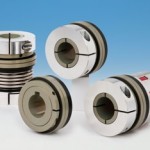
torque limiter R+W America’s new torque limiter, the SL Series, utilizes a proven spring-loaded ball detent system, along with a previously patented preload for zero-backlash operation.

To achieve its target of 50-percent weight reduction, R+W embarked on a two-year collaborative effort with local universities, designing the product from the ground up rather than simply redesigning or optimizing existing products. The result is a torque limiter constructed from state-of-the-art materials with unique surface treatments and innovative assembly technology – surpassing weight reduction targets and simultaneously reducing its footprint.

In addition to custom material specifications, specially designed spring systems, and some improvements to the ball detent configuration, resulting in a 40 percent increase in torque capacity for a given size, the weight reduction was also achieved through the compression of individual components.

The four sizes (Series 30 / 60 / 150 / 300) cover disengagement torque values from 5 to 700Nm, and involve various mounting options, including both direct and indirect drive versions. Models SLN (clamping) and SLP (keyway) attach by flange to sprockets, sheaves, pulleys and gears, and include an integral dual-bearing system to support belt and chain tension when properly located over the shaft. Models SL2 (bellows coupling) and SLE (servo insert coupling) mount inline between two independently supported shafts, such as motor to ball screw connections, and compensate for the small but inevitable misalignment which exists in this type of machine layout. All four types are field adjustable, and come with both English and metric bores according to customer specifications.

www.rw-america.com

R+W America’s new torque limiter, the SL Series, utilizes a proven spring-loaded ball detent system, along with a previously patented preload for zero-backlash operation.

To achieve its target of 50-percent weight reduction, R+W embarked on a two-year collaborative effort with local universities, designing the product from the ground up rather than simply redesigning or optimizing existing products. The result is a torque limiter constructed from state-of-the-art materials with unique surface treatments and innovative assembly technology – surpassing weight reduction targets and simultaneously reducing its footprint.

In addition to custom material specifications, specially designed spring systems, and some improvements to the ball detent configuration, resulting in a 40 percent increase in torque capacity for a given size, the weight reduction was also achieved through the compression of individual components.

The four sizes (Series 30 / 60 / 150 / 300) cover disengagement torque values from 5 to 700Nm, and involve various mounting options, including both direct and indirect drive versions. Models SLN (clamping) and SLP (keyway) attach by flange to sprockets, sheaves, pulleys and gears, and include an integral dual-bearing system to support belt and chain tension when properly located over the shaft. Models SL2 (bellows coupling) and SLE (servo insert coupling) mount inline between two independently supported shafts, such as motor to ball screw connections, and compensate for the small but inevitable misalignment which exists in this type of machine layout. All four types are field adjustable, and come with both English and metric bores according to customer specifications.

Low weight, low inertia torque limiter
October 1, 2010 by  
Filed under Featured, Industry News, Torque Limiters

By Tobias Wolf, Product Engineer, R+W GmbH and Andrew Lechner, Product Manager, R+W America.

The concept of weight reduction through the use of high tech materials is not a new one.  But for those involved in the design of motion control and automation systems, the elimination of excess mass and inertia is often the difference between success and failure.  Energy savings, higher throughput rates, and reduced downtime, all without compromise to quality or accuracy, are on the minds of almost every machine design engineer today.  To address this requirement R+W has introduced a revolutionary new torque limiter, SL Series, with half the inertia and less than half the mass, allowing for a rapid and automatic recovery from torque overload even in the most advanced drive technology.

r and w america SLP 60 A4

The use of mechanical torque limiters is often considered to be outdated by those who prefer to control torque overload through electronic current limitation.  While this is effective in many cases, as machinery becomes more dynamic, the inertia of moving parts becomes more critical.  It is indeed possible to abruptly decelerate a rotating mass through unintentional blockage or application of a dynamic braking system at a faster rate than the drive would normally accelerate.  This creates torque overload through reflected inertia which is completely independent of the electronic system, and can easily exceed the peak torque rating of the motor.  While older and bulkier designs may be out of the question, these modern mechanical torque limiters offer a high level of sensitivity and accuracy, with increasingly smaller impact on the size, mass, balance, and power consumption of the drive system.

R and W America SL Group Photo

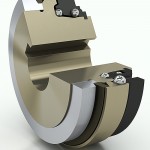
The SL Series uses the proven spring loaded ball detent system, along with a previously patented preload for zero backlash operation.  But to achieve its target of 50% weight reduction, R+W embarked on a two year collaborative effort with local universities, designing the product from the ground up rather than simply redesigning or optimizing existing products.  The result is a torque limiter constructed from state of the art materials with unique surface treatments and innovative assembly technology – surpassing weight reduction targets and simultaneously reducing its footprint.  One example of this newly achieved size reduction is a torque limiter rated to disengage at 160 Nm, which in the past would have had at best a mass of 1.3 kg and a moment of inertia of 1.6 * 10-3 kgm2, now weighs 370 grams with a moment of inertia of 0.8 * 10-3 kgm2.  What that amounts to is an automatic torque limiter with unparalleled power density on planet earth.

In addition to custom material specifications, specially designed spring systems, and some improvements to the ball detent configuration, resulting in a 40% increase in torque capacity for a given size, the weight reduction was also achieved through the compression of individual components. This, of course, is without negative impact on the precision or service life of the torque limiter.  The SL Series, just like the previously existing R+W torque limiter designs, can handle in excess of 10,000 disengagement events, depending on rotational speed.

The four sizes (Series 30 / 60 / 150 / 300) cover disengagement torque values from 5 Nm to 700 Nm, and involve various mounting options, including both direct and indirect drive versions.   Models SLN (clamping) and SLP (keyway) attach by flange to sprockets, sheaves, pulleys, and gears, and include an integral dual bearing system to support belt and chain tension when properly located over the shaft.  Models SL2 (bellows coupling) and SLE (servo insert coupling) mount inline between two independently supported shafts, such as motor to ball screw connections, and compensate for the small but inevitable misalignment which exists in this type of machine layout.  All four types are field adjustable, and come with both English and metric bores according to customer specifications.

R+W America
www.rw-america.com

High Torque Motor Turns At Speeds Up To 3,500 RPM
July 8, 2010 by  
Filed under Torque Limiters

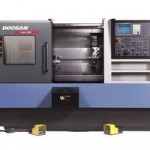
torque limiter1 Today’s turning centers can be economical without sacrificing power or precision. Demonstrating this is the Lynx 300, a new turning center from Doosan that’s just now entering the United States.

The Lynx’s 20 Hp, high torque motor provides the power for heavy cuts and the speed to produce near-mirror finishes. Its 10″ diameter 3-jaw power chuck turns 3″ bar stock at speeds up to 3,500 rpm, and its recommended price is well below others that do less and cost more.

The Lynx’s bed is a one-piece Meehanite casting to absorb vibration and help dissipate heat, while its heavy ribbing resists twisting and distortion. A 30° slant bed maintains a minimal and constant distance between tool tip and guideway. This maximizes rigidity while eliminating distortion under heavy loads. The headstock is mounted on the same plane as the tailstock to assure perfect alignment and center height regardless of the bed temperature. Widely-spaced linear motion guideways allow high-speed rapid traverses – 945 IPM on the X-axis, and 1,181 on the Z.

Each axis is driven by a large diameter, high precision ball screw that is selected for its outstanding combination of accuracy, rapid traverse speeds, and high feed thrust. The ball screws are mounted directly to the A.C. servo motors. This design minimizes backlash for superior machining accuracy. Ball screws on each axis are protected in case of a crash by an electric torque limiter. Upon impact, the torque limiter senses the load and immediately reverses the servo motor and stops the axis movement.

Lynx’s 12-station turret features an 8.26″ diam. curvic coupling and 11,465 lbs of hydraulic clamp force. This configuration provides high rigidity for superior accuracy and surface finish, long boring bar overhang ratios, and extended tool life. Indexing repeatability is +/-0.0005°. Turret indexing is non-stop and bi-directional, with 0.15 sec. next-station index time. A rotary encoder determines the turret position, and a proximity switch confirms the clamp.

Additional standard features of importance include a waylube separation system, a tool setter that eliminates skim cuts and manually entering tool offsets, automatic forced lubrication, coolant system with a 42 gal. coolant tank, and a part catcher. The controller is a Fanuc 0iTD.

www.doosaninfracore.co.kr

Slip Systems for Wind Turbine Generator Protection
August 25, 2009 by  
Filed under Featured, Torque Limiters

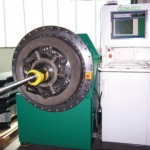
CENTA produces an enhanced version of its Torque Hub, the slip clutch which offers a simple and low-cost design for torque overload generator protection.

Centa Torque limiter

In wind power plants, electrical circuit problems are known to cause short-term torque peaks. In this event, slip clutches protect the costly gearbox against overload by slipping at a defined maximum torque in order to temporarily interrupt the drive.

The slip process takes place not on the generator shaft surface, but inside the CENTA Torque Hub, which is mounted on the generator shaft in the coupling’s clamping set.  CENTA’s latest development in slip systems-”CENTA Torque Set”-now positions the slip unit to the middle section of the shaft. By relocating the slip function, manufacturing tolerances at the generator shaft no longer cause variations in the slip torque, resulting in improved accuracy of the slip function.

Another advantage of the new design is that the slip system is made to be pre-mounted as a complete unit. The maximum torque is set on a certified test bench according to the manufacturer’s requirements and documented in a test report, eliminating the need for on-site adjustments.  The low-maintenance slip system is also designed to allow for multiple slip processes (> 200) without having a major impact on the slip torque setting. Depending on the size, a torque range of up to 120 kNm is covered. The new slip system can also be provided as a low-cost system component which does not include the coupling unit.

Precision Torque Limiter with Clamping Hub

December 16, 2008 by  
Filed under Torque Limiters

R+W torque limiters provide inexpensive insurance with little effect on machine performance. Utilizing a patented preload internal to it’s ball-detent mechanism, R+W torque limiters are all backlash free and highly responsive, with the ability to completely disconnect the drive and driven components in under 3msecs. Disengagement torque can be adjusted in the field, and several disengagement behaviors are available.

r%20and%20w%20SK%20Clamping
The newest design from R+W utilizes a single screw radial clamping hub in place of the traditional tapered conical clamping connection. Available in English or metric bores, with or without keyways, the SK1 with clamping hub allows for simple and convenient mounting, as well as the ability to perform quick shaft phase adjustment in the keyless version. Available for bore diameters of 3-80 mm (0.118 – 3.150”) and disengagement torques from 0.1-1800 Nm (0.89 – 15,930 in-lbs) R+W torque limiters accommodate a wide range of applications within a small envelope.

www.rw-america.com
