
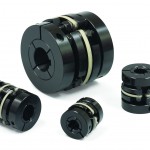
Misumi Now Offers Comprehensive Line Of Couplings

August 12, 2010 by  
Filed under Bellows, Disk, Featured, Industry News, Miniature, Oldham, Servo

MISUMI Coupling types include high precision Single Disc and Double Disc Clamping models, many of which may be used with servomotors.  Also offered are Oldham, Slit and N Couplings, as well as Jaw, Sleeved, Bellows, and Resin types, in a variety of sizes and configurations.

misumi couplings2

The SCXW is a Double Disc type precision disc clamping coupling with high torque but no backlash.  Its torsional rigidity is up to 26% higher than conventional (standard) disc clamping couplings. It suits applications requiring fast positioning precision.  All the bolts are trivalent chromate plated and suitable for use in clean environments.

The MFJGWK is available as a high rigid Oldham coupling, set screw type. The MFJCGWK is a high rigid Oldham coupling, clamping type.  Both products feature an aluminum bronze spacer and have a keyed bore.  These couplings have allowable torque 2X higher compared to resin spacers.

The SCOC is a short Oldham coupling, clamping/spacer type. This space-saving version works with miniature devices because it is 17% shorter than conventional types.

Most MISUMI Couplings ship in six days, with the exception of the new High Rigid Oldham Couplings, which ship in eight days.  Some couplings offer optional express shipping for faster delivery.

MISUMI USA, Inc.
Http://us.misumi-ec.com

Low Inertia Aluminum Couplings Reduce Cycle Time

April 28, 2010 by  
Filed under Flexible, Servo

The aluminum CD® model is a low inertia, lightweight coupling with high torsional stiffness for servo motor applications. It is available in single and double flex versions.

Zero Max aluminum CD Couplings

“We surveyed design engineers to find out what was the most desirable feature when specifying couplings for servo motor applications,” reports Robert Mainz, Zero-Max sales manager. “Low inertia was the most important.” These engineers said they continually look for ways to reduce cycle time and improve system productivity. A lightweight yet high strength coupling design will let you increase the speed of the actuator. Lightweight couplings will also have an effect on the energy consumption in their designs.

The working part of the CD® coupling is made of a special composite material. The composite disc design withstands the stresses of a servomotor’s high acceleration rates and high torque capacity better than other coupling designs. This results in lower energy requirements, and longer life of the motor and other operating components while ensuring uninterrupted system operation.

Zero-Max CD couplings are available in single and double flex models with or without keyways. The double-flex version is for precision applications requiring misalignment capacity greater than the single flex design. The single flex models have a torque capacity range from 40 Nm to 1436 Nm and beyond with speed ratings from 4400 RPM to 17,000 RPM.

Zero-Max
www.zero-max.com

High Misalignment, Low Inertia Servo Couplings

January 25, 2010 by  
Filed under Bellows, Featured

The trend in industry to process more material, faster and more efficiently calls for a high torque, high misalignment, low inertia servo coupling, with minimal compromise to torsional stiffness. Stainless steel bellows couplings have the highest torsional stiffness of commercially available flexible couplings, making them the best choice for aggressive servo driven applications. But in cases where the two shafts to be connected are mounted to different bearing surfaces, it can be difficult to maintain the precise alignment tolerances normally required.

r and w america BKZ couplings

Utilizing a special, high stiffness bellows and new, high strength connection method, the BKZ handles an average of 2.6x the traditional torque rating at a given outside diameter, and an average of 2.9x more lateral misalignment, opening up the benefits of precision bellows couplings to a whole new segment of machine design and servo motion control.

Accepting bore diameters ranging from 15 to 60mm and torque ratings from 20 to 1000Nm, the BKZ range is available in 4 sizes, with a variety of materials, finishes and the optional self-opening clamp system. View online at http://www.rw-america.com/bellows_couplings/bellow-coupling-bkz-t.php

R+W America
www.rw-america.com

How to Properly Choose Servo Couplings

November 2, 2009 by  
Filed under Servo

R+W Coupling Technology recently proposed a system on how to properly select your servo couplings.  They state that servo systems require mechanical components with  high torsional stiffness in order to perform properly in applications requiring rapid acceleration and deceleration of high inertia loads. Flexible couplings usually have the lowest torsional stiffness of any component in a motion system. Couplings are often selected based on factors other than torsional stiffness, often to the detriment of system performance.  Proper servo coupling selection can pay off when considering the overall picture.
torsional deflection R+W also say engineers go to great lengths to ensure that inertia mismatch between the load and the servo motor is compensated for. Motors and gearheads must be selected in order to ensure the ability of the drive to be able to accelerate the load with ease. The mechanical connection between the drive and the load can however unvaryingly compromise the efforts of the drive system. The most compliant component in the mechanical system (e.g. the coupling) will be twisted back and forth by the settling motion of the load at any major velocity change. The formula provided by R+W for calculating torsional deflection based on load and stiffness is as follows:

torsional deflection f = torsional deflection (degrees)
TAS = peak torque (Nm)
CT = torsional stiffness of coupling (Nm/rad)

Depending on the inertia of the load and its effect on peak torque, this can happen to varying degrees. In any case, more power is required in order to accelerate the load at the desired rate when a less rigid component is installed between the drive and the load. According to R+W, this may or may not pose a concern depending on the application, and tends to be of higher importance in cases with a high inertia load that must be rapidly indexed.

When tuning servo drives, R+W claims that velocity and position feedback loops must be set to a low enough frequency so as not to excite the most torsionally compliant component in the system by reaching its natural frequency. Higher coupling stiffness leads to a higher natural frequency of the entire system, which means that feedback loops can be set to a higher frequency. This leads to a faster moving, more accurate machine, and ultimately higher throughput and higher quality.

A commonly used calculation by R+W for determining required coupling stiffness, and / or maximum drive frequency, utilizes what is called the “two-mass system.” In practice, if the calculation is carried out based on coupling stiffness alone, the calculated resonant frequency of the load has to be at least twice as high as the excitation frequency of the drive.

resonant frequency

resonant frequency fe = Resonant frequency of the system (Hz)
CT = torsional stiffness of coupling (Nm/rad)
JL = Moment of inertia, load (kgm^2)
JA = Moment of inertia, drive (kgm^2)

Bellows couplings quite simply posses the highest torsional stiffness of commercially available flexible couplings, and are considered by many to be the standard for servo applications. Hydroformed from a continuous tube of stainless steel, bellows can easily flex laterally, angularly, and axially with only very gentle restoring forces, while remaining highly rigid in rotation. This, paired with a low moment of inertia, according to R+W, makes bellows couplings appropriate for almost any application requiring optimum efficiency and performance in acceleration and positioning.

The exception lies, says R+W,  in cases where neither a high level of dynamic positioning accuracy, nor the ability to optimize servo loop gains is critical. A vibration damping coupling can be a very dependable and a low cost alternative in these cases. When pushing the limits of efficiency, accuracy, and speed, the most torsionally rigid coupling possible should be used in order to design the best servo system possible.

http://www.rw-america.com/index.php

High Torque Servo Couplings

July 6, 2009 by  
Filed under Servo

Heavy duty torque ratings and high strength conical clamping hubs make BK3 couplings the choice for high torque servo gearboxes. Manufactured with a double-walled stainless steel bellows to absorb parallel, angular and axial shaft misalignment, the BK3 has an extremely high torsional stiffness to complement its relatively very low moment of inertia – allowing it to handle rapidly indexing and reversing servo applications.

rw bk3

These unique couplings are manufactured with a tapered conical clamping element, which results in the highest shaft clamping forces, without keys, compared to any other hub design. The BK3 coupling also incorporates unique disassembly screws to aid the mechanic in tight spaces.

The clamping sleeves are custom bored on each side for shaft diameters from 10 to 80 mm ( 0.39 to 3.13 in.). Sizes are available for torque capacities ranging from 15 to 10,000 Nm (133 to 88,500 in. lbs.).

R+W America
www.rw-america.com

Hydraulic Pumps Benefit From Zero-Max CD® Couplings

February 27, 2009 by  
Filed under Servo

Plymouth, Minnesota: New CD Couplings® from Zero-Max are an ideal choice for use with fixed displacement hydraulic pumps driven by servo motors. CD Couplings provide the ideal combination of high dynamic load capacity and high torsional stiffness to ensure reliable system operation.
2ccda7d931e494fad885026293a434e2
“This new pump drive technology has become increasingly popular because of dramatic improvements in their energy efficiency and noise reduction”, reports Robert Mainz, Zero-Max sales manager. “These pump systems utilize the power and precision that only a servo motor can provide. The system pressure is controlled by modulating the output volume of a fixed displacement pump. This is made possible utilizing a high performance control system and the high performance qualities of a CD shaft coupling.”

CD couplings have unique design qualities that are robust to ensure that these hydraulic pump applications are reliable and productive. CD Couplings are designed so that the working part is made of a composite material. The composite disc design withstands the punishment and stress of a servo motor, “everything a variable speed pump drive system can dish out,” report OEM designers. They also report that CD couplings enable these systems to not only perform well in test lab environments, but more importantly, on the production floor.

CD Couplings are available in single and double flex aluminum hub models with or without keyways. The single flex models have a torque capacity range from 40 Nm to 1436 Nm and beyond with speed ratings from 4400 RPM to 17,000 RPM.

All CD couplings are environmentally friendly and are manufactured of RoHS compliant materials.

For more information, call 1-800-533-1731 for FREE brochure. Outside US and Canada, call 763-546-4300.

www.zero-max.com

For the Best Load Control Look to Bellows Couplings

Properly selected bellows couplings result in the best control over the load in any servo application. Here are tips to ensure you choose the right size for the application.

jan%20mech%20feat%201
Bellows couplings help maintain tight controls over loads.

For years, bellows couplings have been a mainstay for efficient motion systems because they offer high torsional stiffness, low moment of inertia, and minimal restoring forces under misalignment. They may help maintain tight control over loads, which is especially critical when considering that the flexible coupling often represents the point of least stiffness in an electromechanical system. In this way, couplings have a significant effect on the stability of the entire system, as well as the postional accuracy of the load. Bellows couplings benefits include misalignment compensation paired with precise transmission of velocity, angular positioning, and torque.

Read more
