Explosion proof couplings
August 16, 2010 by llangnau
Filed under Flexible, Industry News, Safety
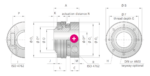
Flexible couplings are a critical component for applications involving potentially explosive materials found in automotive paint and cleaning stations, chemical plants, and powder mixing areas. A lack of radially flexible elements in shaft linkage can result in high radial loads on shaft bearings, eventually leading to heat generation and bearing failure, making flexible shaft couplings essential to machine drive design in these cases. Even more critical is that the potential for sparks must be eliminated. For use in explosive environments R+W has developed a full range of ATEX certified “explosion proof” couplings in accordance with the European directives, ATEX 95 and ATEX 137.
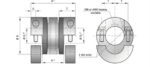
These special couplings are precision machined with a thermally and chemically stable, wear resistant, polyurethane insert press fit between the two for zero backlash. A smooth fit between the insert and the hubs helps the insert to compensate for lateral, angular and axial shaft misalignment. The insert is impregnated with graphite, giving it electrically conductive properties, eliminating the potential for any charges arcing from one hub to the other. Official serialized markings including the part number are required by the directive and are clearly visible on each unit.
These precision couplings are available in a variety of mounting configurations, and can include torque overload protection. There are nine total sizes ranging from torque ratings of 2 – 2150 Nm (17 to 19,000 in-lbs). Both English and metric bore diameters are available in a range from 3 – 80 mm (1/8 to 3.125 in.) with or without keyways.
R+W America
www.rw-america.com
2009 BK Series Catalog from R+W
May 26, 2010 by kzipp
Filed under Industry News
Stainless steel bellows couplings have grown more prevalent, driving the development of a wide variety of mounting configurations, wall thicknesses, lengths, torque ratings, etc.
The 2009 BK series catalog from R+W represents the latest collection of standard bellows coupling designs for applications requiring torque ratings from 15 Nm – 10,000 Nm. Flanges, shafts, hollow bores and nearly any other mechanical interface are accommodated.

R+W America
www.rw-america.com
Elastomer couplings with higher torque handling capacity
May 5, 2010 by llangnau
Filed under Elastomer, Flexible, Industry News, Torque Limiters
The growing popularity of curved jaw (elastomer) style couplings for precision applications has driven the need for couplings that handle more than the traditional torque capacity of 2,150 Nm up to a maximum torque of 25,000 Nm.
Available with split clamping collars or keyway and set screw connections, the three new body sizes allow for backlash free, vibration damping power transmission, paired with strong torque density. Dual flexture and jack shaft versions are also available for spanning longer distances and compensating for larger misalignments. Unlike the pre-existing range of R+W elastomer couplings, which use a single spider element between the new hubs, the new larger sizes will use individual vibration damping compensation elements to fit between each mating set of coupling teeth. These couplings are available in English and metric bore diameters up to 170 mm.
R+W America
www.rw-america.com
6 ways to assess torque needs for safety couplings
Safety couplings that operate on the ball detent principle primarily suit disengagement torque applications. But, with some modification, they can suit highly dynamic applications with resonant frequencies and torsional rigidity. Here is a brief examination of common equations used to calculate the following torques for safety coupling design in a drive system: disengagement torque, acceleration torque, acceleration and load moment, thrust force, resonant frequency, and torsional rigidity.
Disengagement torque. The disengagement torque must be greater than routine torque moments within a drive train. First, determine torque requirements within the drive train. In practice, a multiplication factor of 1.5 times the nominal operating torque is often adequate to accommodate acceleration moments and other influencing factors. To calculate minimum torque ratings for a drive train, use the following equation:
TKN ≥ 1.5 x TAS
Where:
TKN = torque in the drive train (Nm)
TAS = Peak torque in the drive train (Nm)
Peak torque is usually taken from the rating plate on the given drive mechanism.
You can use the number 9,550 as a constant value to convert power into Nm. Thus:
TKN ≥ 9,550 x PAN/n x 1.5
Where:
PAN = Power of the driving side (kW)
n = speed (rpm)
Acceleration torque. The acceleration torque method is a more accurate technique. In addition to angular acceleration, it makes allowances for peak torque on the driving side, the mass distribution, and the moments of inertia inherent to the driving and driven ends. With the help of a correction factor (surge or load factor) established according to the machine and application, acceleration torque can be determined using this method. Normally, a distinction is made between three types of surge or load factors:
SA = 1 (harmonic strain)
SA = 2 (periodic strain)
SA = 3-4 (non-periodic strain)
The following equation reflects these relationships:
TKN ≥ α x JL ≥ (JL/JA + JL) x TAS x SA
α = Angular acceleration (s-2)
JL = Moment of inertia on the load side (kgm2)
JA = Moment of inertia on the driving side (kgm2)
SA = Surge or load factor
Acceleration and load torque. The most accurate but complex assessment of torque for the evaluation of safety couplings is the acceleration and load torque method (start-up under load). This approach simulates an application in which constant acceleration and deceleration under load conditions takes place. Load torque is used as an additive factor to acceleration torque.
The following equation, with differentiation of individual variables, describes this relationship:
TKN ≥ a x JL + TAN ≥ [(JL/JA + JL) x (TAS – TAN) + TAN] x SA
TAN = Peak torque for the load side (Nm)
These three design methods are based on manufacturer data for the drive and the load components. In addition to torque moments, only moments of inertia and potentially incurred acceleration are included.
Thrust force. Another option for assessing application torque is the thrust force method. This method can be applied to spindle and lead screw drives as well as toothed belt drives, depending on the design of the drive system.
In addition to overall thrust force for the entire unit, thread pitch and efficiency play substantial roles in the proper design of spindle and lead screw drives. Here is the equation for the applied torque:
TAN = (s × Fv)/2000 × ∏ × η
s = thread pitch (mm)
Fv = thrust force (N)
η = efficiency
∏ = pi
If the drive and load are not linked by way of a spindle or lead screw, but by a toothed belt drive, use the following equation to calculate the incurred torque:
TAN = (d0 × Fv)/2000
d0 = pinion diameter of the toothed pulley (mm)
Resonant frequency. Each body and component in the drive train has its own natural frequency. The resonant frequency of the coupling and the entire drive system can be approximated with the following equations. A prerequisite for the calculations is the summation of mass moments of inertia of the individual components to determine the total mass moment of inertia. The torsional rigidity of the entire drive train also has a big influence on oscillation. The equation for calculating the coupling’s resonant frequency in Hz is:
ƒe = 1/2p x √CT x ((JA + JL)/(JA x JL))
The equation for calculating the natural oscillation in speed is:
ne = 30/p x √CT x ((JA + JL)/(JA x JL))
ƒe = resonant frequency of the system (Hz)
CT = Torsional rigidity of the coupling (Nm/rad)
ne = Natural oscillation term of the system (rpm)
Torsional rigidity. Whether a machine is designed to be rigid or damping depends on the respective application. The rigidity of all individual components, including the coupling, should always be taken into account. In theory, if a body twists by a defined angle if it is subjected to a certain load (torque). The degree of twist depends on the rigidity of the body (countering the torque). This relation is expressed:
φ= 180/p x TAS/CT
R+W America
Compact Precision Torque Limiters from R+W America
March 30, 2010 by llangnau
Filed under Industry News, Torque Limiters
Based on a compact and simple design, the ESL series torque limiters from R+W offer accurate performance at a reasonable cost. Unlike traditional ball-detent torque limiters, the ESL spring loads two series of ball bearings against one another to create a rolling effect at overload.

The rolling effect reduces wear and at the same time lets the clutching interface serve as the bearing support during overload disengagements, saving space and cost. This torque limiter uses a specially developed “digressive spring characteristic,” so sensitivity to overload and torque disengagement accuracy are not compromised. Disengagement takes place within 3 milliseconds of overload, and at a value within +/-5% of the disengagement torque setting. The basic design mounts with a keyway and set screw; customized mounting attachments are also available. Technical specifications, solid models, and video are available at:
R+W America
http://www.rw-america.com/elastomer_couplings/torque-limiting-coupling-esL-t.php
Six factors to remember about couplings in a motion system
Physical values such as torque, torsional rigidity, spring stiffness, moment of inertia, imbalance, and zero-backlash play a major role in coupling design. Here are a few facts to keep in mind when you design your motion system.
Torque (Nm): is the product of an acting force and the effective length of the acting force’s lever arm.
T = Fxr
T = Torque (Nm)
F = Force (N)
r = Lever arm (m)
With a force of 100 N and a 1 m long lever arm, you can generate a torque of 100 Nm. Or, you can generate a torque of 100 Nm with a force of 1000 N and a 0.1 m long lever arm. For couplings, a specific amount of torque can be achieved with a large outer diameter of the coupling and a correspondingly low acting force or with a small outer diameter and a correspondingly high acting force.
Torsional rigidity (Nm/rad): refers to the rigidity of a coupling when it is subjected to a torsional load. If the torque exceeds the maximum torsional value of the coupling, the coupling will no longer be strong enough to transmit the acting rotational force. Ex: If a coupling with a torsional rigidity of 10 000 Nm/rad is subjected to 10 Nm, the connection element will twist by 1/1000 rad. That is equal to an angle of twist of about 0.057 degrees (1 rad = 57°17’44.8”). For a torsionally rigid or vibration damping coupling, this angle of twist may still be within the admissible range. In practice, torsionally rigid couplings normally have a maximum angle of twist of less than 0.05 degrees and vibration damping couplings have a maximum angle of twist of less than 5 degrees.
Spring Stiffness (N/mm): is the counterforce exerted by the coupling in case of differentiated position of the axes in an axial, radial, and lateral direction. Ex: If the axial spring stiffness of a coupling is 30 N/mm, the coupling will exert a force of 30 N in the case of an axial displacement of 1 mm. These forces are important in a design with couplings, particularly when selecting bearings or other drive system components.
Moment of inertia: is the moment resistance when the rotational speed is changed. Normally, the lower the total weight and the smaller the outer diameter of the coupling body, the lower the moment of inertia. The reverse is also true, the higher the weight and larger the outer diameter, the higher the moment of inertia. This feature is important in highly dynamic applications because the drive has to generate sufficient torque to overcome a body’s moment of inertia to accelerate and decelerate.
Imbalance: in a drive system, imbalance should be as low as possible for smooth operation. Caused by asymmetries in the drive system where mass is distributed unevenly, it affects centrifugal forces on the entire drive system. It can be rectified by “balancing bores,” which are normally drilled directly into the location of the disproportionally high concentration of mass.
Zero backlash: is a lack of empty space or “play” when the rotational speed, direction of rotation, or torque changes. It does not mean that there is no angle of twist. Backlash is an important factor in predicting bearing life.
Information courtesy of R+W America
For safety, electronics may not be the best choice
The trend of replacing mechanical systems with electrical systems continues. Even developers of hydraulic and pneumatic systems are following it. But, as is becoming evident through the latest unintended acceleration issues, electronic components can have a few drawbacks that should not be overlooked in a design.
When in comes to designing a system for safety, specifically when considering whether to choose a mechanical component such as a coupling, or to go electronic, remember this: Electronic safety components have two major disadvantages compared to mechanical safety components.
- Reaction time. Assume a machine crashes and causes an overload. According to engineers at R+W America, a signal from the monitoring circuit does not reach the motor controller until 5 to 7 ms following a sharp increase in torque. During this period of latency, the controller attempts to further increase torque to reach the setpoint value. Most likely, another 10 ms will pass before the motor is shut off. Depending on the drive train’s moments of inertia, more time can pass before the electronics brings the whole system to a stop.
- Multiple potential failure sources. Electronic monitoring systems need multiple sensors for data. Between the monitoring system and all of its sensors and other components, you have a system with multiple possible points of failure.
A mechanical safety coupling, on the other hand, completely disconnects the drive from the load within 3 to 5 ms; 1/3 of the time needed by an electronic cut-off. Noted engineers at R+W America, “electronic machine monitoring is not suitable for high speeds due to the large centrifugal mass of the rotating parts.”
Also with a mechanical safety coupling, you have one component per axis, reducing the number of possible points of failure.
Safety couplings must demonstrate two clear behaviors:
- Upon overload, separation of drive train and load should occur within a few milliseconds.
- After the coupling has disengaged, residual friction should not be excessive so as not to damage coupled components that continue to be driven due to mass moments of inertia.
According to R+W, safety couplings can be subdivided into five classes:
1. Rigid safety couplings used in indirect drive applications.
2. Torsionally rigid safety couplings for use between two shafts or flanges. These couplings resist twisting and can be subdivided into two groups.
A. Single-piece torsionally rigid safety couplings.
B. Press-fit couplings.
3. Vibration-damping safety couplings are fitted with an elastomer insert that damps incurred drive vibration.
4. Economy safety couplings suit applications requiring simple overload protection and functions as a variation of the ball-detent principle.
5. Torque-limiting line shafts, which span long distances between shafts.
(Some material, courtesy of R+W America.)
EZV Series Adjustable Line Shafts from R+W America
February 18, 2010 by CouplingTips
Filed under Beam, Bellows, Linear
A convenient location for manual phase adjustment along a mechanical drive system is now available in the EZV series adjustable line shafts. Making use of a high strength intermediate collar between two telescoping sections of precision tubing, the EZV naturally places the location for phase adjustment in an easily accessible, open space. Due to the relatively large outside diameter of the drive tubing, the EZV also provides for a more secure clamping connection than would exist when clamping over standard diameter motor and gearbox shafts.
Length adjustability also results from this design, making the EZV reusable in different machine layouts, and easier to install, especially with certain alternate hub designs, like EK7 expanding mandrels and EK6 high strength conical clamp ends. For any size the EZV can also be made with ZAE torsionally rigid bellows couplings, or with integral ES2 mechanical torque limiters.
R+W America
www.rw-america.com
High Torque Servo Couplings
July 6, 2009 by CouplingTips
Filed under Servo
Heavy duty torque ratings and high strength conical clamping hubs make BK3 couplings the choice for high torque servo gearboxes. Manufactured with a double-walled stainless steel bellows to absorb parallel, angular and axial shaft misalignment, the BK3 has an extremely high torsional stiffness to complement its relatively very low moment of inertia – allowing it to handle rapidly indexing and reversing servo applications.

These unique couplings are manufactured with a tapered conical clamping element, which results in the highest shaft clamping forces, without keys, compared to any other hub design. The BK3 coupling also incorporates unique disassembly screws to aid the mechanic in tight spaces.
The clamping sleeves are custom bored on each side for shaft diameters from 10 to 80 mm ( 0.39 to 3.13 in.). Sizes are available for torque capacities ranging from 15 to 10,000 Nm (133 to 88,500 in. lbs.).
R+W America
www.rw-america.com
For the Best Load Control Look to Bellows Couplings
February 17, 2009 by Andrew Lechner and Andreas Rimpel
Filed under Bellows, Industry News, Servo
Properly selected bellows couplings result in the best control over the load in any servo application. Here are tips to ensure you choose the right size for the application.

Bellows couplings help maintain tight controls over loads.
For years, bellows couplings have been a mainstay for efficient motion systems because they offer high torsional stiffness, low moment of inertia, and minimal restoring forces under misalignment. They may help maintain tight control over loads, which is especially critical when considering that the flexible coupling often represents the point of least stiffness in an electromechanical system. In this way, couplings have a significant effect on the stability of the entire system, as well as the postional accuracy of the load. Bellows couplings benefits include misalignment compensation paired with precise transmission of velocity, angular positioning, and torque.