A Novel Way To Use Jaw Couplings In Extreme Temperatures
June 29, 2010 by CouplingTips  
Filed under Jaw

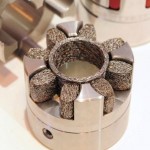
The German couplings specialist, KTR, has come up with a novel way to use jaw couplings in temperatures too high for the elastomer materials conventionally used for coupling spiders. It has developed a spider made from “knitted” steel wire, similar to the steel wool used to clean pots and pans.

Standard spiders are made from thermoplastic polyurethane materials that can be used in temperatures from –30° to +90°C. The materials are produced in various hardness ratings, depending on the damping capacity and the torsional stiffness required. Both of these parameters are linked closely to the operating temperature.

jaw coupling has knitted spider wire to counter high temperaturesKTR’s knitted-wire spider (above) allows vibration-damping couplings to operate in temperatures from –40°C to +180°C without affecting their torque capacities, torsional stiffness or damping. For an ambient temperature of 30°C, the characteristic curves of the knitted-wire spider are similar to those of standard elastomer spiders.

KTR expects the benefits of the knitted spiders to be most significant for applications with operating temperatures above 120°C. The stainless-steel spiders are also suitable for use in corrosive environments.

The knitted-wire spiders can be used with steel, cast-iron or hard-coated aluminium hubs. Initially, KTR is producing the spiders for its Rotex couplings. Damping figures are the same as for elastomer versions, while torque capacities and torsional stiffness are said to remain almost constant, even under permanent loads. The steel spiders are available in sizes from 14 to 90, corresponding to rated torques from 12.5–3,600kN (with peak torque ratings twice as high).

www.KTR.com

New Jaw Couplings Have Zero Backlash

December 18, 2009 by CouplingTips  
Filed under Featured, Jaw

Zero backlash jaw couplings that are three piece couplings comprised of two hubs and a plastic element are one of Ruland Manufacturing’s new products in their coupling line.

The Spider, shown below, made of an advanced polyurethane material, provides dampening of impulse loads, minimizing shock to the motor and other sensitive equipment.

Jaw Coupling

Available in two durometers, these spiders allow the user to customize the jaw coupling’s performance. Selecting a soft spider will give the jaw coupling the greatest dampening characteristics, while a hard spider will provide the greatest torsional stiffness and strength. All spiders are press fit onto a curved jaw profile, assuring zero backlash operation. The curved jaw profile concentrates the forces to the center of the spider’s limbs, improving the effectiveness of the elastomer material. Raised contact points on the spider limbs help maintain proper spacing between the two hubs, assuring electrical isolation and full angular misalignment capabilities.

Jaw couplings are considered fail safe because, even if a spider fails, the jaws of the two hubs interlock allowing direct power transmission, allowing the application to be safely shut down for maintenance.

www.ruland.com