Maintenance free couplings for heavy engineering
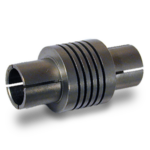
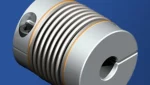
Extreme temperature ranges, high pollution levels, high vibration levels, and 24/7/365 operation call for engineered drive components which can take the abuse. Extending component maintenance intervals is a priority, since industrial gearboxes, electric motors, bearings, and drive shafts typically require at least partial disassembly and replacement of wear parts. A new solution involves zero maintenance, stainless steel bellows couplings for up to 100,000 Nm, engineered to run smoothly for decades.
One challenge in the development of the BX series was the design of the metal bellows itself. The bellows serves to alleviate misalignment loading between adjacent bearing sets while transmitting rotary power. Traditional sizing calculations were used at first, having proved successful for high speed servo drive systems, which tend to be some of the most demanding of the customary applications for bellows couplings. After a short time it became clear that a widely marketable high torque bellows coupling could not be designed without FEA, as the first installed models were two to three times larger than the final product design. As life testing later confirmed, the software revealed some errors in the initial interpretation of the sizing, demonstrating that the traditional methods did not scale properly. In collaboration with a major bellows hydroformer, R+W reviewed and updated these traditional bellows sizing methods to better reflect the realities of what the formed bellows can tolerate in this physical size range.
A special welded joint between the bellows, intermediate tubing, and mounting flanges was also selected, involving a combination of TIG (perfect root) and MAG (low heat generation). This welding method is a recent development of RWTH Aachen University IME, a world renowned leader in mechanical and electrical engineering research, and has demonstrated superior fatigue characteristics in vibration and life testing. With these two important features in place, hubs, flanges, and intermediate tubing, fabricated from high strength steel, were configured to round off the complete product line. R+W has been able to launch the all new “BX” series, with a variety of standard and custom mounting options available, and presently broken down into three specific series.
BX1 with Flange Mounting
The BX1 is the basic model from which the complete BX series is configured. Mounting flanges are welded directly to the bellows, which are then used for adaptation to shaft mounting systems in the cases of the BX4 and BX6. Power is therefore transmitted through the BX1 by means of a frictional flange connection. A common misconception is that the torque is transmitted through the bolts themselves. This can have two negative consequences in that the coupling would exhibit backlash, and that ultimately the bolts would fatigue and fracture. In case of reversing applications or those with frequent load variation this failure would occur within a very short amount of time. Basically torque ratings of flanges are calculated based on the pressure generated by the bolt circle arrangement, the diameter into which they have been arranged, and the coefficient of friction of the flange surfaces. A number of safety and application factors are normally added to ensure a pure high-pressure frictional connection results.
BX4 with Keyway Mounting
The BX4 is described as a low backlash coupling, which transmits torque purely though the form fit of a shaft key or spline. Some potential for backlash always exists due to the clearance required to fit the hub over the shaft. However reduced, this is even in the case of an interference fit, and especially in cases where only set screws are used for the axial retention of the hub. The main advantage of a keyway connection is the quick and easy installation and removal of the coupling hubs. In lieu of keyway connections, spline connections provide additional security and surface area contact with superior stress distribution characteristics. In consideration of some extra cost, this can be a good solution for a more compact design, as the necessary shaft engagement length can then be reduced. Generally speaking, the BX4 is well suited to unidirectional drive applications, which must accelerate, even to high speeds, and maintain those speeds for prolonged periods. Drive systems with shock loading, reversals, and high duty cycles are better served by the BX1 and BX6 designs.
BX6 with Conical Clamping Ring
The BX6 makes use of a high pressure, keyless, frictional clamping connection. The conical clamping ring system consists of two components: the clamping ring and the hub. The clamping ring is drawn over a slotted tapered section of the hub by means of a set of fastening bolts. Sliding the two tapered surfaces against one another creates a high level of surface pressure in the vertical direction, compressing onto the cylindrical shaft. The resulting contact force eliminates the need for keyways and is suitable for transmitting extremely high torque levels depending on the diameter of the shaft. Since the BX6 has many planes of symmetry across its length, it is also well suited to very high rotational speeds, as a result of the low residual imbalance.
Variable Length with Internal Support
The intermediate section of the BX series consists of high strength steel tubing with adapter flanges common to the full product line. The length of the intermediate tubing section can be specified according to customer requirements and interchanged for machinery modifications as needed. The adapter flanges are made with a gimbal system which extends through the inside of the bellows and engages a concave receptacle on the opposite side. This support system causes the entire mass of the intermediate section to be carried by the shafting rather than the flexible bellows. It also serves as a safety feature in the event of a machine crash. Should the bellows or its connection be caused to fail by extreme overload, the tubing would still not be allowed to escape from the hubs, eliminating the need for coupling guards in some cases. This safety feature does not exist in flex disc or universal drive shaft products.
Summary and Outlook
The all new “BX” series offers standard torque ratings of up to 100,000 Nm and bore diameters of up to 280 mm. This technology provides a viable alternative to steel disc couplings, with improved torsional stiffness, balance, and safety features. Flexible design configurations allow for the BX to be made to suit applications with specialized flanges, hubs, materials and surface treatments for even the harshest of environments. The internal support system provides for a high degree of security unavailable in other similar types of couplings. The symmetrical design of the series BX1 and BX6 allows for an optimal balance quality in highly dynamic drive systems and test stands, with ISO Grade 2.5 certification available upon request.
The principle of the formed metal bellows as an equalizing element offers many unique performance advantages for today’s advanced drive technology. Designs capable of transmitting up to 2,000,000 Nm are currently in development.
R+W America
www.rw-america.com
Compact stainless steel bellows couplings
May 19, 2011 by llangnau
Filed under Bellows, Industry News
The BKS series of stainless steel, welded bellows couplings are up to 1/3 shorter in length, reducing moment of inertia and saving space. Manufactured in Germany, the BKS makes use of 1.4301 (304) stainless steel hubs, precision machined to a high level of concentricity. Laser welded while mounted onto a common shaft to guarantee straightness, the couplings compensate for shaft misalignment and precisely transmit motion with zero backlash. Allowable temperatures range from -40 to +300° C. The BKS coupling is available in 6 sizes, with torque ratings from 15 to 500 Nm and English or metric bores from 12 to 75 mm.
R+W America
www.rw-america.com/bellows_couplings/index.html
Wind Turbine couplings deliver 100,000 Nm of torque
January 31, 2011 by llangnau
Filed under Bellows, Flexible, Industry News
Zero-Max Wind Turbine Couplings are now available as an upgrade replacement for existing wind turbines and for OEM applications. These couplings easily handle torque spikes and high misalignment installations. They have composite disk packs at both ends of a center spacer for strength and generous flexibility. The composite disk packs (flex elements) allow a surplus of parallel and axial misalignment while remaining torsionally stiff through all harmonic ranges of the wind turbine’s oscillating load.
Depending on the application, the center spacers can be machined out of steel, composite glass fiber, or 6061-T6 aluminum. Through the use of Finite Element Analysis (FEA), these center spacers can be engineered to withstand in excess of 100,000 Nm of torque.
These wind turbine couplings have many additional design advantages. The flex elements electrically insulate the turbine’s generator from the gear box, eliminating stray electrical current that can leak across the coupling, thus preventing bearing damage to the gear box. The coupling protects the generator by transferring lower reaction loads to the generator bearings. Also, the coupling’s composite material withstands all types of environmental elements, including temperature extremes from -40 to +70° C, and also moisture and chemicals native to the nacelles of wind turbines.
Zero-Max
www.zero-max.com
Compact safety coupling
January 19, 2011 by llangnau
Filed under Bellows, Industry News, Safety
Making use of the existing BKC line of compact bellows couplings, the SL2 safety coupling is a compact, flexible and torsionally rigid option with integral torque overload release. Designed for aggressive servo driven applications, it is completely backlash free, relying on preloads and frictional connections, along with a hydroformed stainless steel bellows to relieve bearing loads resulting from misalignment.
In the event of a machine crash, power surge, or any other cause of unanticipated overload, the SL2 will disengage the motor or gearbox shaft from the load in less than 3 milliseconds. Re-engagement takes place automatically with slow speed rotation of the shaft subsequent to the overload occurrence. Available in four sizes, it handles a range of disengagement torque values from 5 to 400 Nm, and English or metric shaft diameters from 12 to 60 mm.
R+W America L.P.
www.rw-america.com
Misumi Now Offers Comprehensive Line Of Couplings
MISUMI Coupling types include high precision Single Disc and Double Disc Clamping models, many of which may be used with servomotors. Also offered are Oldham, Slit and N Couplings, as well as Jaw, Sleeved, Bellows, and Resin types, in a variety of sizes and configurations.
The SCXW is a Double Disc type precision disc clamping coupling with high torque but no backlash. Its torsional rigidity is up to 26% higher than conventional (standard) disc clamping couplings. It suits applications requiring fast positioning precision. All the bolts are trivalent chromate plated and suitable for use in clean environments.
The MFJGWK is available as a high rigid Oldham coupling, set screw type. The MFJCGWK is a high rigid Oldham coupling, clamping type. Both products feature an aluminum bronze spacer and have a keyed bore. These couplings have allowable torque 2X higher compared to resin spacers.
The SCOC is a short Oldham coupling, clamping/spacer type. This space-saving version works with miniature devices because it is 17% shorter than conventional types.
Most MISUMI Couplings ship in six days, with the exception of the new High Rigid Oldham Couplings, which ship in eight days. Some couplings offer optional express shipping for faster delivery.
MISUMI USA, Inc.
Http://us.misumi-ec.com
GERWAH® Product Line
May 24, 2010 by llangnau
Filed under Bellows, Disk, Elastomer, Flexible, Industry News, Miniature, Safety, Servo, Torque Limiters
The GERWAH® line of products consists of magnetic couplings, metal bellows couplings, servo-insert couplings, line shafts, RING-flex® couplings and safety couplings. These couplings are available in a range of sizes and torque capacities to 3,800 lb-ft. The low mass of the lightweight construction helps increase machine performance and reduce energy costs.
Ringfeder Power Transmission USA Corporation markets a range of power transmission components and keyless shaft/hub technology. Other power transmission products include shock absorbing devices, flexible elastomeric couplings, flexible disc couplings and torque limiters along with other specialty and custom made products.
RINGFEDER
Six factors to remember about couplings in a motion system
Physical values such as torque, torsional rigidity, spring stiffness, moment of inertia, imbalance, and zero-backlash play a major role in coupling design. Here are a few facts to keep in mind when you design your motion system.
Torque (Nm): is the product of an acting force and the effective length of the acting force’s lever arm.
T = Fxr
T = Torque (Nm)
F = Force (N)
r = Lever arm (m)
With a force of 100 N and a 1 m long lever arm, you can generate a torque of 100 Nm. Or, you can generate a torque of 100 Nm with a force of 1000 N and a 0.1 m long lever arm. For couplings, a specific amount of torque can be achieved with a large outer diameter of the coupling and a correspondingly low acting force or with a small outer diameter and a correspondingly high acting force.
Torsional rigidity (Nm/rad): refers to the rigidity of a coupling when it is subjected to a torsional load. If the torque exceeds the maximum torsional value of the coupling, the coupling will no longer be strong enough to transmit the acting rotational force. Ex: If a coupling with a torsional rigidity of 10 000 Nm/rad is subjected to 10 Nm, the connection element will twist by 1/1000 rad. That is equal to an angle of twist of about 0.057 degrees (1 rad = 57°17’44.8”). For a torsionally rigid or vibration damping coupling, this angle of twist may still be within the admissible range. In practice, torsionally rigid couplings normally have a maximum angle of twist of less than 0.05 degrees and vibration damping couplings have a maximum angle of twist of less than 5 degrees.
Spring Stiffness (N/mm): is the counterforce exerted by the coupling in case of differentiated position of the axes in an axial, radial, and lateral direction. Ex: If the axial spring stiffness of a coupling is 30 N/mm, the coupling will exert a force of 30 N in the case of an axial displacement of 1 mm. These forces are important in a design with couplings, particularly when selecting bearings or other drive system components.
Moment of inertia: is the moment resistance when the rotational speed is changed. Normally, the lower the total weight and the smaller the outer diameter of the coupling body, the lower the moment of inertia. The reverse is also true, the higher the weight and larger the outer diameter, the higher the moment of inertia. This feature is important in highly dynamic applications because the drive has to generate sufficient torque to overcome a body’s moment of inertia to accelerate and decelerate.
Imbalance: in a drive system, imbalance should be as low as possible for smooth operation. Caused by asymmetries in the drive system where mass is distributed unevenly, it affects centrifugal forces on the entire drive system. It can be rectified by “balancing bores,” which are normally drilled directly into the location of the disproportionally high concentration of mass.
Zero backlash: is a lack of empty space or “play” when the rotational speed, direction of rotation, or torque changes. It does not mean that there is no angle of twist. Backlash is an important factor in predicting bearing life.
Information courtesy of R+W America
EZV Series Adjustable Line Shafts from R+W America
February 18, 2010 by CouplingTips
Filed under Beam, Bellows, Linear
A convenient location for manual phase adjustment along a mechanical drive system is now available in the EZV series adjustable line shafts. Making use of a high strength intermediate collar between two telescoping sections of precision tubing, the EZV naturally places the location for phase adjustment in an easily accessible, open space. Due to the relatively large outside diameter of the drive tubing, the EZV also provides for a more secure clamping connection than would exist when clamping over standard diameter motor and gearbox shafts.
Length adjustability also results from this design, making the EZV reusable in different machine layouts, and easier to install, especially with certain alternate hub designs, like EK7 expanding mandrels and EK6 high strength conical clamp ends. For any size the EZV can also be made with ZAE torsionally rigid bellows couplings, or with integral ES2 mechanical torque limiters.
R+W America
www.rw-america.com
High Misalignment, Low Inertia Servo Couplings
January 25, 2010 by CouplingTips
Filed under Bellows, Featured
The trend in industry to process more material, faster and more efficiently calls for a high torque, high misalignment, low inertia servo coupling, with minimal compromise to torsional stiffness. Stainless steel bellows couplings have the highest torsional stiffness of commercially available flexible couplings, making them the best choice for aggressive servo driven applications. But in cases where the two shafts to be connected are mounted to different bearing surfaces, it can be difficult to maintain the precise alignment tolerances normally required.

Utilizing a special, high stiffness bellows and new, high strength connection method, the BKZ handles an average of 2.6x the traditional torque rating at a given outside diameter, and an average of 2.9x more lateral misalignment, opening up the benefits of precision bellows couplings to a whole new segment of machine design and servo motion control.
Accepting bore diameters ranging from 15 to 60mm and torque ratings from 20 to 1000Nm, the BKZ range is available in 4 sizes, with a variety of materials, finishes and the optional self-opening clamp system. View online at http://www.rw-america.com/bellows_couplings/bellow-coupling-bkz-t.php
R+W America
www.rw-america.com
Innovative Steel Bellows Coupling Released
October 26, 2009 by CouplingTips
Filed under Bellows, Featured
When first examined, steel bellows couplings seem to be the same superficially, but as one looks at the technical details, they will find there are substantial differences. The construction, structure and manufacturing quality of the steel bellows are the main factors for operational safety, reliability, service lifetime, misalignment capability and functional safety of the entire coupling. Other quality-influencing factors are the connection of the bellows to the hub components and the shaft-hub connections. They influence, for example, the transmittable torque and the coupling running characteristics decisively.

The backlash-free Primeflex steel bellows coupling
The backlash-free primeflex can be plugged in for easy installation and disassembly. It can be dismantled safely without putting the steel bellows at risk even after longer operating times. Herein lies one of the decisive technical advantages. On many other plug-in steel bellows couplings, there is a risk of damaging or even destroying the steel bellows when loosening the plug-in connection (tribo-corrosion effect on the conic hub). primeflex features specific material and geometry to fix this problem.
The extremely compact and high performance-density primeflex can be mounted easily onto the shafts via clamping or shrink disk connections. Another outstanding performance characteristic is the excellent misalignment capability of the new cost-effective steel bellows coupling. It compensates for axial, radial and angular shaft misalignments. The torque is transmitted via frictional locking or via frictional and positive locking. Furthermore, the internal mechanism integrates a stop in order to avoid bellows damages which can occur with excessive mounting pressure.
Primeflex Couplings currently come in three sizes that offer nominal torques ranging from 24 to 120 Nm. In the field of shaft couplings, Mayr power transmission has specialised in backlash-free couplings in servo power transmission services. With its steel bellows, elastomer and disk pack couplings, the company is able to provide the three most common constructional designs for this power transmission segment.
Steel bellows coupling are most often utilised to enable a power transmission between a motor and a reducer or a shaft, while allowing a correction of misalignment. The Main applications include all kind of machines (food processing, machine-tool, packaging…).